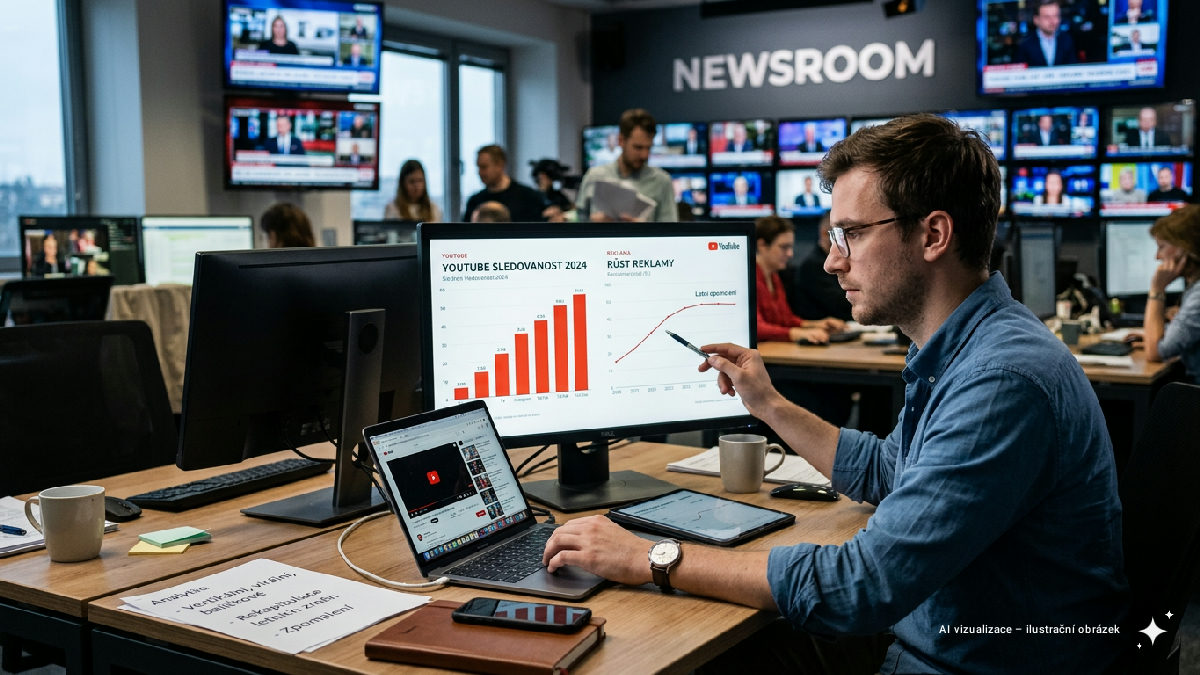
In April this year, American viewers' attention was drawn to dramas like The Pitt from HBO Max, which accumulated 4.5 billion minutes watched. Nevertheless, YouTube emerged as the king of viewership, dominating 13.4% of the US market according to Nielsen’s Media Distributor Gauge. Although the platform dominates global time spent on video, its financial engine is starting to show signs of fatigue in its battle with more aggressive competitors.
Despite its massive reach, which includes 2.6 billion monthly users and annual advertising revenues of around 40 billion dollars, YouTube faces a slowdown in growth. The analytics company WARC points out that while the platform successfully battles for living rooms and competes with linear television, competitors like TikTok and Netflix are beginning to surpass it in monetization efficiency. Users spend an average of 58 minutes daily on YouTube (an increase from 48 minutes in 2024), but the conversion of this attention into dollars is not as steep as expected.
YouTube generates the highest total time spent on any video platform, but its ad revenue growth lags behind the rest of the market.
Vertical Video as a Global Billion-Dollar Business
While YouTube fights for TV screens, the digital market has been swept by the fever of the 9:16 vertical format. According to reports from Holywater Tech and Owl & Co, the global vertical video market (excluding China) will reach 150 billion dollars this year, representing a year-on-year jump of over 40%. The key drivers are so-called micro-dramas, short episodic series designed for mobile phones.
The boom in vertical content is confirmed by the following market predictions:
- Micro-drama apps — specialized platforms will generate 4 billion dollars in revenue this year.
- MPA long-term outlook — micro-drama revenues outside China are expected to grow to 9.5 billion dollars by 2031.
- ReelShort — the flagship product of Crazy Maple Studio is heading towards annual revenues of 1.05 billion dollars.
New players and seasoned veterans are entering this segment. RoseBerry Media launched the Epis platform, which uses its proprietary AI solution Red Snapper to reformat existing brands for mobile audiences. Similarly, Y+X Entertainment Group is building the LumiCreator network, having already attracted over 50 creators, including New York Times bestsellers, for its upcoming service LumiView. Investors are also keeping pace, supporting the studio New Short Media under the umbrella of 5X Media.
Alliances of Giants and Service Bundling
The answer to market fragmentation is increasingly large strategic alliances. In the US, NBCUniversal and YouTube have entered into a multi-year partnership that will link Peacock Premium subscriptions directly with the YouTube Premium bundle starting in early 2027. NBCUniversal will also use YouTube Primetime Channels to sell Peacock as an add-on channel and expand collaboration on Comcast's Xfinity and Xumo platforms.
The global vertical video market outside China will grow by 40% this year to a total of 150 billion dollars.
This trend of “bundling” is also not shying away from major players like Disney+. It has formed a global alliance with TikTok, under which selected user-generated content from TikTok will start appearing directly in the “Verts” section of the Disney+ app. The goal is to increase user engagement and leverage the popularity of short videos to promote main titles. Similarly, Netflix is strengthening ties with creators like Nick DiGiovanni and Alan Chikin Chow to attract their loyal online communities to paid streaming.
“YouTube has been less successful than rivals like TikTok in convincing marketers of its role in achieving conversion goals, and is therefore increasingly focused on winning a larger share of TV budgets.”
Battle for Content Gateways and the Role of AI
Whoever controls the TV operating system controls the viewer. A Hub Entertainment Research study confirms that TV OS operators have become the most important “gatekeepers” of the streaming era. In the US, Roku dominates, with people most often naming it as their primary gateway to content (37%), followed by Fire TV (17%) and Android (14%). This strategic importance was underscored by Fox Corporation's 22 billion dollar acquisition of Roku.
Parallel to technological battles, content creation itself is changing. Jonathan Yunger, a veteran of Millennium Media and head of Arcana Labs, is betting on artist-driven artificial intelligence. His goal is not to replace creators, but to use AI to protect the integrity of stories and reduce the costs of independent production. Yunger believes that AI will enable increased production value even for projects with limited budgets, thereby changing the economics of independent film.
What will the immediate future bring? Netflix, through its chiefs Greg Peters and Ted Sarandos, has admitted to considering free ad-supported tiers (FAST) in selected markets, but does not plan anything of the sort in the short term for fear of cannibalizing paid tiers. The free channel market is thus still occupied by players like Samsung TV Plus, Rakuten TV, and wedotv, which is currently expanding into India. The decisive battle for viewers' attention in the coming months will therefore take place at the intersection of TV screens and smartphone vertical displays.