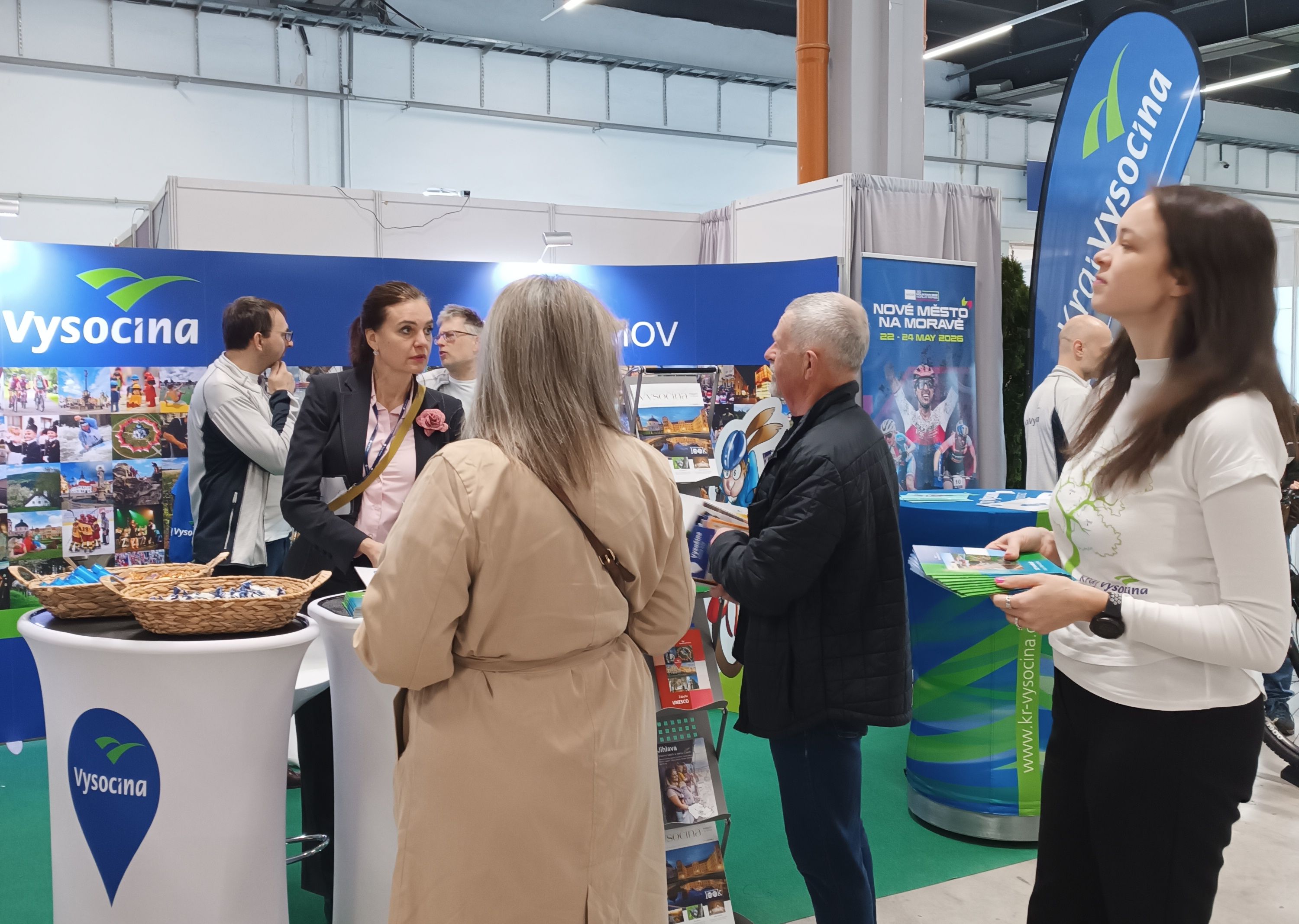
In Wrocław, Poland, families with children are examining a new illustrated map of attractions, in Vienna, Austria, thousands of people are interested in a quiet holiday in nature, and in Seoul, South Korea, awareness of the region in the heart of Europe is growing. Vysočina is no longer an unknown place for foreign tourists, and its popularity abroad is confirmed by rising statistics of accommodated guests and successful presentations at key European trade fairs.
According to current data from Vysočina Tourism, more than 700,000 visitors stayed in the region in 2025. Of this total, people from abroad accounted for 14%, which represents almost 93,000 tourists. Compared to 2024, this is an increase of 4.6%. The region is thus becoming a sought-after destination for those seeking authentic experiences without mass tourism, benefiting from its strategic location and good accessibility from the capital.
The number of foreign visitors to Vysočina increased by almost five percent in 2025, reaching 93,000 accommodated guests.
Neighbors lead, but distant markets also attract
The structure of foreign clientele shows that the region is dominated mainly by neighboring countries. Slovaks make up a quarter of all foreigners, followed by Germans with a share of 19.7%, and Poles, more than 10% of whom visit Vysočina. A surprising figure from the Czech Statistical Office data is the increase in interest from the Republic of Korea, from which 2.2% of foreign guests arrived last year.
The region is responding to these trends with targeted promotion, which in the first half of 2026 included participation in several significant events. In Austria, Vysočina presented itself at the Ferien-Messe Wien trade fair, which attracts over 70,000 people. In Poland, it focused on MTT Wroclaw and the April Slow Travel fair in Kielce. Kielce is a sister city of Třebíč, and cooperation with the Świętokrzyskie Voivodeship opens up space for new tourist projects.
Vysočina's foreign marketing activities in 2026 included these key events:
- Ferien-Messe Wien — the most important Austrian trade fair focusing on families and active tourists.
- Fiets en Wandelbeurs Utrecht — the largest Dutch event for 25,000 cycling and hiking enthusiasts.
- Czechia Travel Trade Day — an incoming event for buyers from Austria, Scandinavia, and Asia.
- Slow Travel Expo Kielce — presentation of regional tourism and authentic experiences in Poland.
From long-distance cycle routes to UNESCO monuments
Vysočina relies on the concept of “Active & Outdoor Travel”. In February, the region was presented in Utrecht, Netherlands, where the local market primarily seeks quiet routes away from the main tourist flows. In April, the organization for the first time in history organized a pre-tour for travel agency buyers from more than 20 countries worldwide, including China and Scandinavia, to show them the region directly in the field.
The region is newly focusing on the Israeli market, which annually generates more than a quarter of a million tourists in the Czech Republic interested in family holidays.
In May, this was followed by a visit from influencers from Israel, who focused on family holidays. During the summer of 2026, the region hosted journalists from France and Germany, as well as bloggers from the Netherlands. All of them explored not only the three UNESCO monuments but also the natural riches of the region, which, according to the organizers, elicit the most positive reactions from foreign guests.
“Vysočina is still a somewhat undiscovered region for Polish travelers, and the fair is a great opportunity to promote it. This year, visitors were particularly impressed by our novelty — an illustrated map of attractions for families with children in Polish,”
Cooperation with Korea and development of Dukovany
Further tourism development is to be supported by closer cooperation with Polish and Korean partners. Regional councilor for tourism Miloš Hrůza sees potential in connecting protected landscape areas and cooperating cultural institutions. South Korea plays a specific role. Interest in this market is not accidental – it is related to the existence of direct flights between Prague and Seoul and the future completion of the Dukovany Nuclear Power Plant by the Korean company KHNP.
Vysočina Tourism director Zdeněk Navrátil confirms that the region's strategy remains unchanged. The goal is to present the region as a center of tranquility and active relaxation without crowds, which is the asset that resonates most with foreigners. Further activities will focus on strengthening the brand abroad and ensuring a sustained increase in inbound tourism.