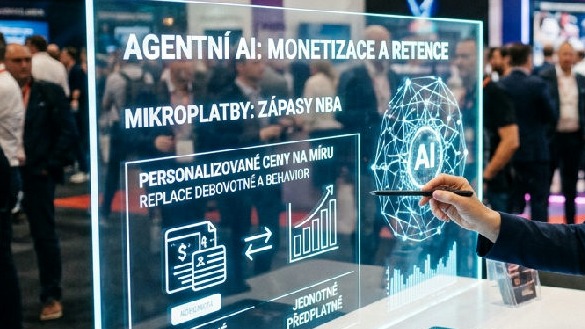
The era of flat-rate subscriptions for everyone is giving way to personalized offers that directly respond to individual viewer behavior. At IBC2026, Evergent presented solutions based on so-called agent artificial intelligence, designed to help streaming service operators more effectively monetize their audience. According to company representatives, AI is moving from the experimental phase into real products that customers commonly encounter.
The main driver of these changes is rising content costs. These force operators to seek more flexible ways to retain subscribers and increase revenue. Evergent uses AI-driven automated revenue orchestration for this. The system can identify when a user is about to cancel their contract and, in real-time, offer them a retention discount or a package tailored to their past preferences.
In 2026, artificial intelligence is moving from laboratories directly to customers, ending the era of universal streaming subscriptions.
End of Universal Packages and the Rise of Micropayments
The personalization trend applies not only to movies and series but is massively penetrating the realm of sports broadcasts. An example is the New Zealand national broadcaster TVNZ, which uses Evergent technologies to sell special access for World Cup matches. Instead of long-term commitments, viewers encounter so-called “event passes”, which allow watching only a specific event.
Craig Ferguson, Associate VP Sales for Europe at Evergent, confirms that the market is moving towards much smaller forms of subscription. In the industry, the term micro passes has taken hold for these. These short-term accesses allow fans to pay only for what they genuinely want to see, a model that the American basketball league NBA is also interested in, according to Ferguson.
Key innovations in streaming monetization include:
- Individual retention offers — automatic generation of discounts for users considering leaving.
- Micro passes — selling access to individual sports broadcasts or time-limited events.
- Agent AI — deployment of intelligent systems for revenue orchestration based on viewer behavior.
- Real-time data analysis — using tools like AI Insider to convert data into business decisions.
Technological Innovations from IBC2026
At the trade fair in Amsterdam, where Evergent is exhibiting at booth 5.A86, other data intelligence-related innovations are also resonating. Setplex introduced the product AI Insider there. This artificial intelligence-powered agent is designed to transform the enormous volumes of data generated by streaming platforms into concrete operational and business insights. The goal is for operators not just to collect data but to act on it immediately.
In addition to software solutions for monetization, innovations in production are also being presented at the event. Nanlite in Hall 11 introduced new LED spotlights FC-1200B and FC-1200C, bringing 1200 W of power to the more affordable FC range. Blackmagic Design in Hall 7 is also attracting attention, demonstrating native support for SMPTE ST 2110 standards and a new version of DaVinci Resolve 21.1 software with enhancements for Blackmagic Cloud.
Personalized viewer engagement and micropayments for sports broadcasts are becoming the new standard for platforms like TVNZ and NBA.
„We’re starting to have conversations with people where they want to have a more personalised engagement with those subscribers and those users.“
Challenges for Viewer Retention
Although the number of broadband subscriptions worldwide has reached 1.6 billion, retaining existing customers remains a critical issue. Services like Netflix are adjusting their prices in response to the market, for example, in the UK, while other major players are trying to curb price increases due to the cost-of-living crisis. This is where technologies for targeted advertising, discussed by Yospace at IBC, come into play.
Paul Davies, Marketing Head at Yospace, stated that their dynamic ad insertion system underwent its biggest test during the World Cup, proving its ability to scale seamlessly. Industry standards are now beginning to unlock new advertising formats and delivery models that supplement subscription revenues. In Hall 8, Lawo is showcasing its Dynamic Media Facility (DMF) approach, which adapts broadcast resources in real-time to changing production requirements.
The future of streaming, according to current trends from Amsterdam, will therefore not belong to fixed monthly payments but to a combination of predictive AI that "saves" the viewer from leaving and flexible payments for premium content. Whether this model will fully replace traditional subscriptions or remain a complement will be shown by the results of current tests at national broadcasters and global sports leagues.