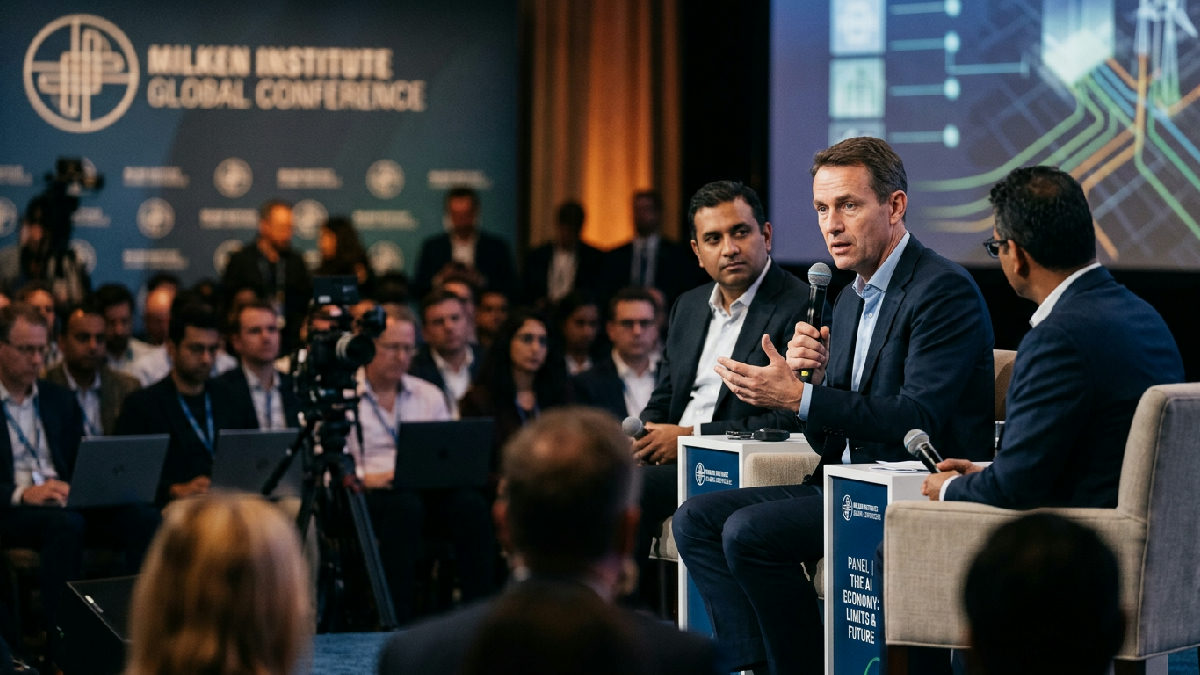
At the recent Milken Global Conference in Beverly Hills, five key figures from the technology sector discussed the future and risks of an economy built on artificial intelligence. The panel, which included representatives from ASML, Google Cloud, Applied Intuition, Perplexity, and Logical Intelligence, revealed that the industry is encountering limits in chip manufacturing, energy, and the very architecture of current models.
Christophe Fouquet, CEO of the Dutch company ASML, which holds a monopoly on machines for lithography of cutting-edge chips, highlighted a critical hardware shortage. According to him, the market will be constrained by insufficient supply for the next two to five years, meaning that tech giants like Google, Microsoft, and Amazon will not receive as many chips as they ordered.
“I believe the market will be supply-constrained for several years, despite the massive acceleration in manufacturing,” Fouquet stated.
Francis deSouza from Google Cloud confirmed the growing demand. The division's revenue exceeded $20 billion in the last quarter, and its backlog almost doubled from $250 billion to $460 billion. In response to energy intensity and lack of terrestrial infrastructure, Google is even considering building data centers in space, where access to solar energy is easier, although cooling in a vacuum through radiation remains a challenge.
In addition to hardware and energy, the discussion also touched upon AI training methodology. Qasar Younis from Applied Intuition, valued at $15 billion, sees the main obstacle in the lack of real-world data, which is essential for autonomous vehicles and defense. According to him, physical world systems cannot be fully trained solely through synthetic simulations. Eve Bodnia from the startup Logical Intelligence went even further, questioning the current concept of large language models (LLMs). Her company is developing Energy-Based Models (EBMs) that do not try to predict words but to understand the rules of the world, similar to the human brain.
At the end of the debate, Dimitry Shevelenko from Perplexity presented the vision of a “digital worker.” Their new Perplexity Computer system is not just a tool but virtual staff capable of autonomous action. To gain the trust of companies, Perplexity relies on granular permission settings and the necessity of user approval of the action plan before the agent makes changes in corporate systems.