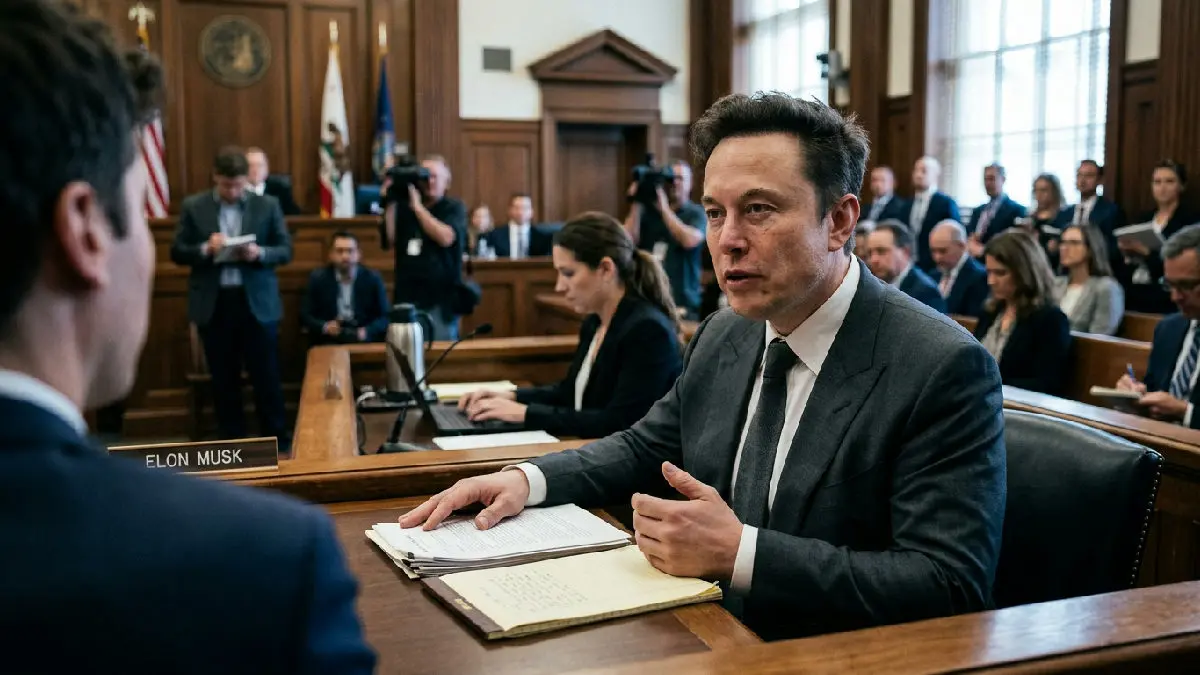
The legal battle between Elon Musk and OpenAI's leadership has entered its crucial phase. Musk, who was instrumental in the organization's inception, accuses Sam Altman and Greg Brockman of a "lure and scam" they allegedly committed by deviating from the company's original non-profit mission in favor of billions in profit. According to the lawsuit filed in 2024, OpenAI, under Altman's leadership, transformed into a de facto closed subsidiary of Microsoft, thereby allegedly violating the founding agreements on the development of artificial intelligence for the benefit of humanity.
During cross-examination, Musk had to defend against questions about the actual amount of his financial contributions. Although he previously stated on social media that he had invested approximately 100 million dollars in OpenAI, he had to admit a lower figure in court. "In monetary terms, I contributed 38 million dollars," Musk acknowledged, adding that his main contribution consisted of his reputation and name, which lent legitimacy to the project. Sam Altman's lawyer, William Savitt, pointed out that Musk stopped paying rent for OpenAI's premises in 2020 after gradually losing control over the company's direction.
My understanding of the agreement with Microsoft was that it would be a limited profit to provide funding and computing power, with the interests of the non-profit organization remaining paramount," Musk stated in court.
Relations between the founders began to crumble especially after 2022 when Microsoft announced a 10 billion dollar investment. Musk testified in court that he was "deeply concerned" by the company's valuation, which then reached 20 billion dollars. According to the plaintiff, it is not possible for Microsoft to provide such amounts for charitable reasons. OpenAI's lawyers, on the other hand, countered by claiming that Musk's lawsuit is merely a jealous attempt to slow down a competitor and promote his own projects, such as xAI or humanoid robotics at Tesla.
In the lawsuit, Musk demands not only the removal of Altman and Brockman from leadership but also damages for the non-profit part of OpenAI amounting to up to 150 billion dollars. He also insists that the company cease operating as a for-profit entity. The defense, conversely, seeks to prove that Musk himself previously rejected a offered stake in the capped-profit division and is now trying to profit ex post from ChatGPT's success through the courtroom.
Judge Yvette Gonzalez Rogers had to admonish the public and Musk himself several times during the proceedings. During his testimony, he did not refrain from sarcastic remarks to OpenAI's lawyers, whom he accused of attempting to "fool the jury." The trial, which has a fundamental impact on the future regulation and definition of Artificial General Intelligence (AGI), will continue with further interrogations of key managers from both sides.