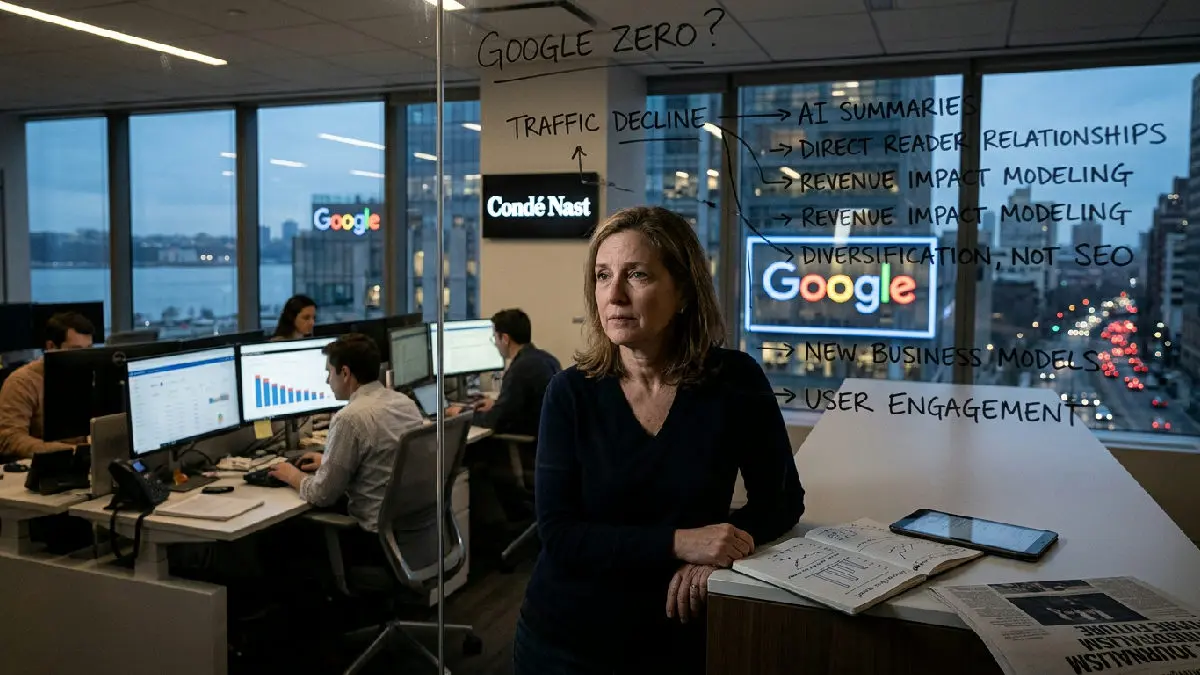
Publishing houses are preparing for a radical market transformation, which they call “Google Zero.” This term describes a future in which the Google search engine ceases to function as the main source of traffic and, thanks to artificial intelligence, becomes the target destination for information itself. According to Chartbeat data, the volume of organic traffic from Google to more than 2,500 monitored websites decreased by a full third last year. Most major players are now creating crisis models for a scenario where user influx from search drops to zero or single-digit percentages.
As part of its strategy, media house Time has developed an internal tool that simulates a complete shutdown of traffic from Google. The goal is to determine the impact on user engagement and revenue. Mark Howard, COO of Time, stated that due to earlier diversification, the impact on business would be relatively small.
“We know exactly what our business looks like without Google. We have built a model that is not dependent on page views,”
said Howard. In the last three years, Time has reduced the share of traffic from Google from 60% to 51%, while the share of direct visits has increased to 30%.
Other major publishers, including lifestyle ones, are working with predictions that anticipate a massive expansion of generative artificial intelligence in search. One model expects that AI answers (so-called AI Mode) will dominate up to 80% of search queries by the end of 2027. SEO teams are therefore preparing for a further decline in traffic of 30 to 40% in the next three years. The strategy is now shifting to building “brand equity” and a direct relationship with readers, so that users search directly for specific brand names, which is a type of query that AI answers will probably not completely replace.
Other key measures include an emphasis on content syndication and platforms that publishers do not directly own. Instead of chasing massive reach through SEO, media houses are focusing on paid subscriptions, newsletters, and video distribution on platforms like YouTube or LinkedIn. According to representatives of business-focused media, it is not necessary to own a platform for a medium to reach its audience. This approach is also supported by a survey among publishers, where 30% of respondents identified activities outside their own websites as the most effective defense against a “zero-click” future.
Some executives admit that despite a 60% decline in Google traffic in the last two years, they managed to maintain growth thanks to new products such as events or advanced advertising tools. The overall message across the market is clear:
“If you plan for Google to go to zero and it doesn't, anything above zero is a bonus. But if you plan for stability and a drop comes, it will be catastrophic,”
concluded one of the interviewed representatives of a lifestyle publishing house.