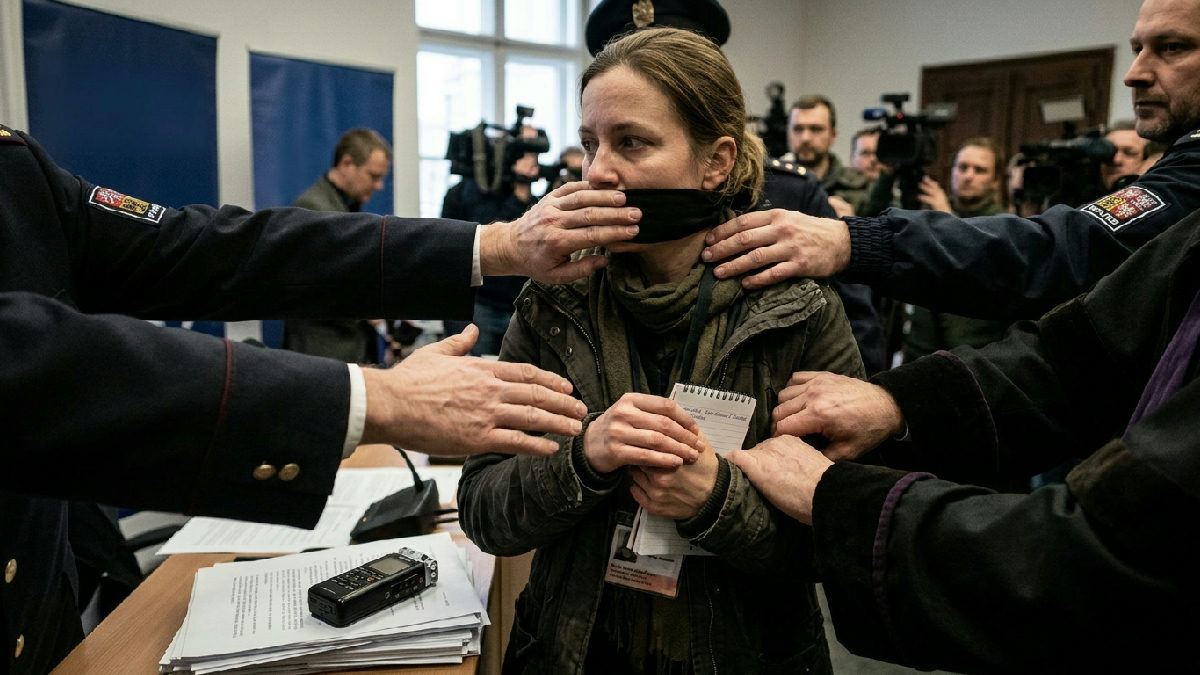
I consider the case where a court allowed the police to investigate with whom journalists from the Czech Justice and Ekonomický deník servers communicated to be extremely serious. Not because journalists should be above the law, nor because the leak of a court document could not be the subject of an investigation. But at the moment when the state starts uncovering the communication of journalists, it touches upon one of the most sensitive safeguards of a free society: the protection of journalistic sources.
It is important to state one thing clearly. Source protection is not a journalist's privilege. It is not a convenient shield for newsrooms. It is the protection of people who choose to provide information in the public interest, often at the risk of personal, professional, or legal consequences. Without such people, the public would never learn much crucial information about the functioning of the state, judiciary, politics, security forces, or major economic interests.
That is precisely why it is truly dangerous if source protection is breached lightly, routinely, or without exceptionally careful justification. It is not enough to say: we are investigating a leak, so we need to find out who called whom. In a democratic rule of law, such an intervention must be truly exceptional and precisely justified. It must be proportionate, and it must be clear that no other, less invasive path existed.
In this case, what is disturbing is precisely that, according to published information, the court practically did not address the issue of journalistic source protection. Yet, this is not a detail. The metadata alone, i.e., information about who communicated with whom and when, can effectively reveal a journalistic source. There is no need to read the content of messages. Sometimes, time, a number, and context are enough.
Naturally, this has a huge impact on the future. Every person who considers whether to provide important information to a journalist may, after such a case, say: I'd rather keep silent. Rather not risk it. And it is at this moment that damage is caused not only to one medium or one journalist. Damage is caused to the public.
The freedom of the media does not only rest on the fact that a journalist can write an article. It also rests on the fact that they receive information in the first place that someone powerful or influential does not want to release. If the state creates an atmosphere in which sources begin to fear, free journalism weakens.
I do not want to assert that this specific case is a politically driven attack. But as someone who has been involved in the media for a long time, I must say that such state action is very alarming. And even more so in the current political atmosphere. Media freedom is not restricted by one big step. It weakens gradually, technically, administratively, through legal steps that at first glance look like a routine procedure.
If we look at Hungary, we see that the path to controlling the media space did not begin with shutting down newsrooms. It began with pressure, questioning, changing rules, economic pressure, personnel interventions, and creating an environment in which newsrooms and their sources began to be careful about what they could still say.
The Czech Republic is not Hungary. And that is precisely why we should be sensitive to moments when similar mechanisms begin to appear in hints. The protection of journalistic sources is one of those places where the true relationship of the state to free media is recognized. Not by the statements of politicians, but by how the state behaves when the media publishes something inconvenient.
Also fitting into this context is the current debate about public service media. If, in addition to cases of interference with source protection, significant efforts emerge to make Czech Television and Czech Radio dependent on the state budget and momentary political will, it is not possible to brush it aside.
Public service media must be subject to criticism. Journalists must be accountable. Newsrooms must work professionally. But that does not mean creating pressure that can lead to self-censorship, fear of sources, and the gradual weakening of independent journalism.
The media is not the enemy of the state. It is a check on power. And if the state starts too easily looking for who talks to journalists, we should all be vigilant. Because next time, it may not be about one court document, one journalist, or one case. Next time, it may be about whether people still dare to tell the truth at all.