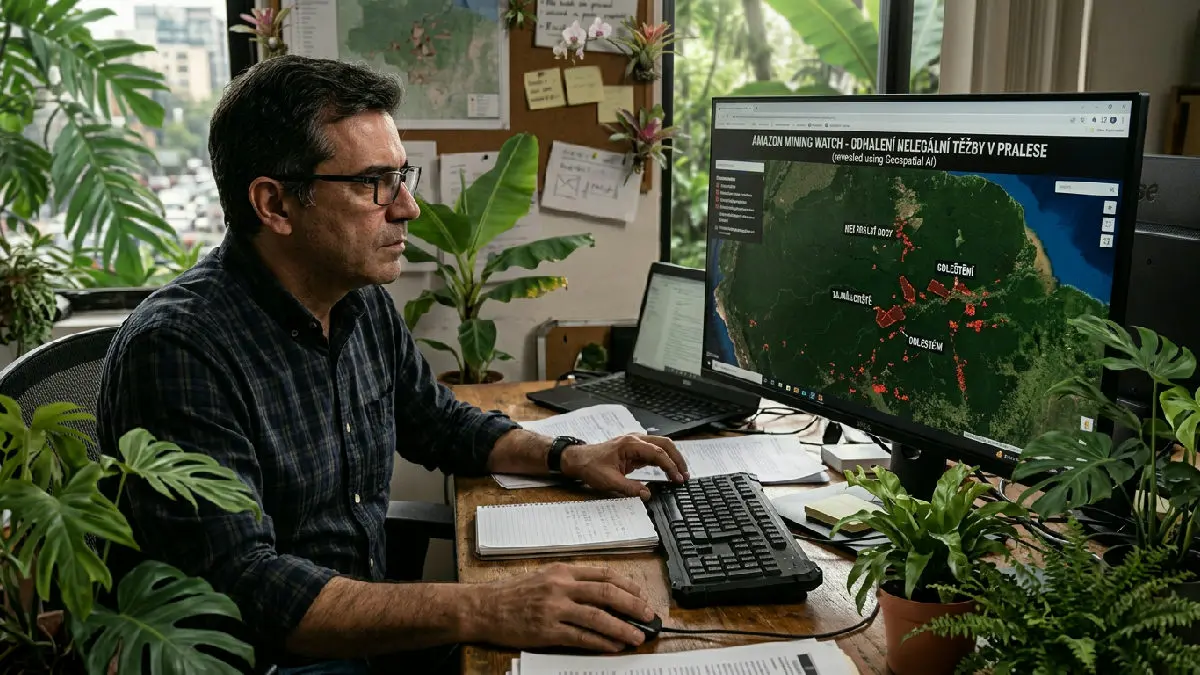
Investigative journalists focusing on environmental issues are undergoing a technological revolution. By combining satellite imagery and machine learning, they can identify illegal activities in places that are physically inaccessible or dangerous for on-the-ground reporters. Artificial intelligence (AI) plays a key role in this process, as it can automatically search through vast amounts of data to find patterns typical of illegal gold mining or the construction of covert airfields.
This approach was pioneered by Venezuelan journalist Joseph Poliszuk, who had to flee the country in 2018 due to persecution by Nicolás Maduro's regime. From exile in Mexico and Colombia, Poliszuk began seeking ways to map the destruction of rainforests remotely. Traditional field research in these areas would require days of travel through dangerous territory controlled by armed groups. However, manually inspecting satellite images of 50 million hectares of rainforest was unrealistic for a small team.
“Thanks to this technology, I can show people the true extent of this phenomenon. We understood that we could monitor from the air what we couldn't achieve on foot,” said Poliszuk.
In collaboration with the non-profit organization Earth Genome and with support from the Pulitzer Center, a machine learning model was developed and trained to recognize specific “scars” on the landscape. During an investigation called “Clandestine Corridor”, 3,718 illegal gold mining sites were identified in the Venezuelan states of Amazonas and Bolívar.
The success of these methods led to the creation of the Amazon Mining Watch platform, which currently monitors activity in nine Amazon basin countries.
The technology is already delivering concrete results in the field. Shortly after the first findings were published in El País, the Venezuelan army announced the bombing of several illegal airfields in the region. Similar projects are now emerging outside South America – the Pulitzer Center and Earth Genome are currently collaborating with Code for Africa to monitor the impacts of mining in the African rainforest.