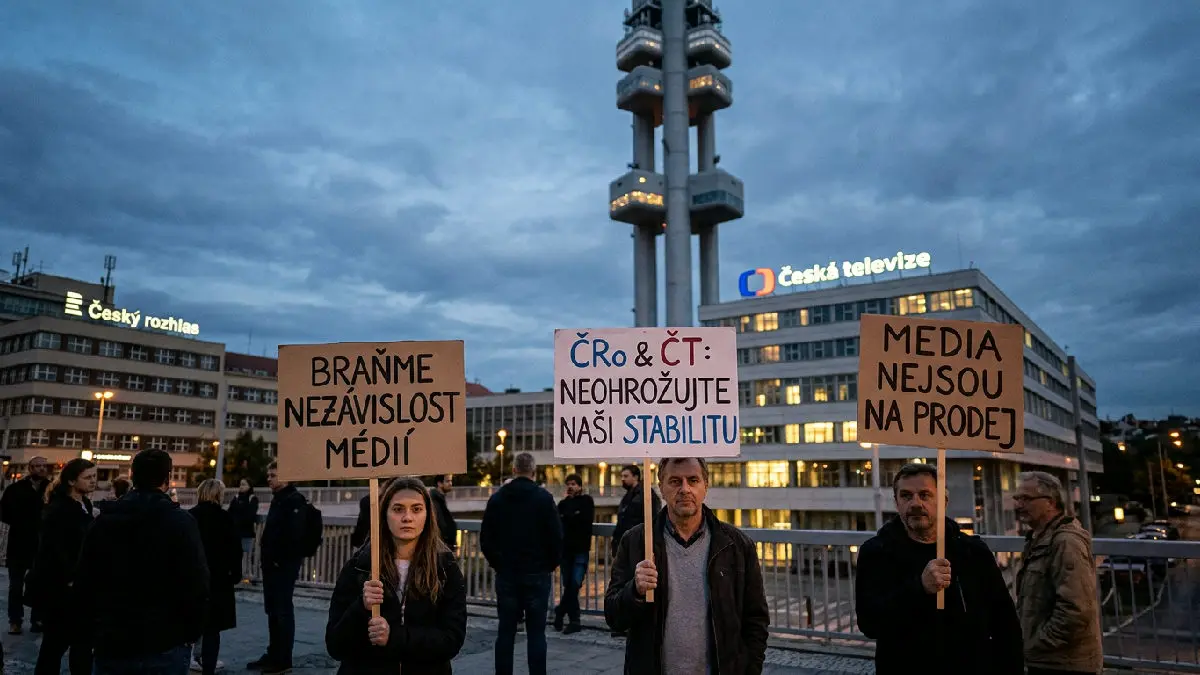
The management of Czech Television (ČT) and Czech Radio (ČRo) has issued a joint critical statement regarding the government's proposed new Public Service Media Act. According to both institutions, the draft in its current form threatens their legal stability, independence, and ability to fulfill their current tasks. Instead of merely changing funding, which the government declared as the main goal, the draft, according to the media, represents a fundamental interference with the principles of public service broadcasting.
The main complaint is directed at the fact that the proposal effectively abolishes the existing statutory establishment of both institutions without clearly guaranteeing the continuity of their rights, assets, and existing commitments. Media representatives warn that such a step creates dangerous legal uncertainty.
In view of the above, we believe that any planned changes should be addressed by an amendment to existing legal regulations, not by a hastily drafted completely new law,” both media state in their declaration, adding that the new law does not meet the quality of current legislation.
The criticism is based on ten key points. One of the most serious is the possible weakening of editorial autonomy. The new text transfers responsibility for content to media councils, which, according to ČT and ČRo, contradicts the prohibition on direct interference by council members in program production. At the same time, the proposal introduces a hierarchy of content, where news and culture are superior to other genres. This relegates entertainment to a secondary role, which, according to the statement, is contrary to the European principle of the triple role of public service media: to inform, educate, and entertain.
In the area of funding, the institutions reject the possibility of accepting donations, grants, and targeted contributions from third parties. This model, they argue, opens the door for undue influence from companies, political entities, or self-governing bodies on broadcasting content. The media also lack clear rules for paying contributions from the state budget and warn that the proposed obligation to publish birth dates of small donors violates personal data protection (GDPR).
The technical and programmatic level of the proposal is also insufficient, according to the media. It lacks the anchoring of regional broadcasting, a network of foreign correspondents, or the operation of on-demand services. The document, according to ČT and ČRo, also contains unrealistic requirements, such as the obligation to provide radio broadcasts with subtitles or sign language for people with sensory disabilities.