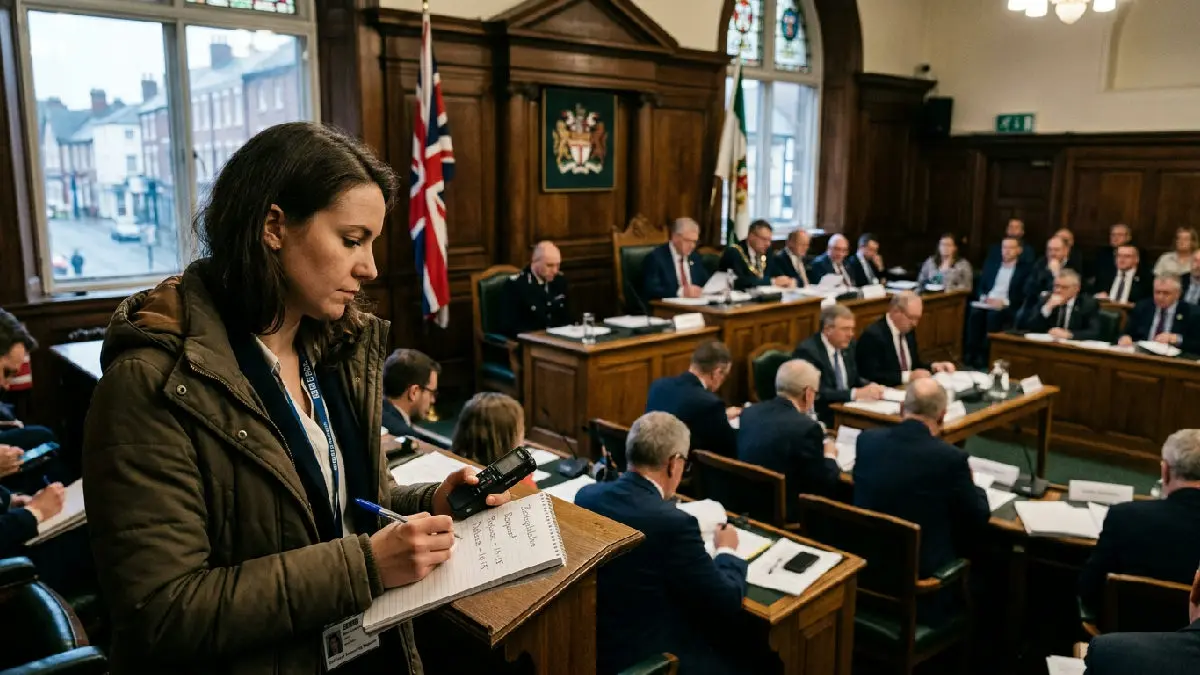
While regional newsrooms in the Czech Republic shrink year by year, journalists observing local councils diminish, and more and more local issues go unchecked by the public, the United Kingdom has decided to address the problem systematically. The British have concluded that local journalism is not just the private business of publishers, but an important part of the democratic infrastructure of the state. Similar to schools, libraries, or public media.
The result is a unique model of support for regional news, which is now being watched by media and governments worldwide.
When Journalists Disappear, Public Oversight Disappears Too
Britain began to perceive the problem more than ten years ago. Traditional regional media were losing advertising revenue, newsrooms were merging, and hundreds of journalistic positions were disappearing. In many cities, no one regularly attended council meetings, regional councils, or public institution committees.
A phenomenon called “news deserts” emerged. These are areas where there are local councils, public budgets, and political decisions, but a lack of journalists to monitor them and explain them to the public.
British studies gradually showed that where local media disappears, citizens' interest in public affairs declines, space for misinformation grows, and the transparency of public administration decision-making decreases.
BBC Came Up with a Revolutionary Solution
In 2017, the BBC therefore launched the Local Democracy Reporting Service (LDRS) project. The idea was simple:
Do not save entire newspapers. Do not pay publishers for operations. Do not influence content.
But to directly fund journalists who will monitor the functioning of local democracy. (Public Media Alliance)
Today, the system works by the BBC funding a network of approximately 165 reporters distributed across 118 regions of the United Kingdom. These journalists are not BBC employees but work for regional publishers, websites, radio stations, or local media organizations.
Their main task is not to write about celebrities, sports, or criminal events. They primarily monitor:
council meetings,
decisions of local authorities,
regional self-governments,
public procurement,
healthcare,
transport,
police,
public finances,
activities of other public institutions.
Articles Belong to Everyone
The most interesting part of the system comes next.
A reporter writes an article. It does not stay only with the media outlet that employs them. It automatically enters a shared database and can be freely used by hundreds of other newsrooms across the country. Today, more than a thousand media brands and hundreds of media organizations have access to the content.
Thus, one reporter can inform residents of an entire region through various media with their article.
In the first few years of operation, hundreds of thousands of articles and reports were created that would probably never have existed without this program.
How is Independence Ensured?
This is often the most common question.
If someone funds journalists, can't they also buy their favor?
The British model attempts to prevent this with several safeguards.
The BBC provides funding but does not dictate content. Reporters are employed by regional media, which bear full editorial responsibility. The BBC does not decide what they will write about, nor how they will interpret individual cases.
Another safeguard is content sharing. Once an article is available to hundreds of newsrooms, it is very difficult to manipulate or politically influence it without competitors noticing.
Moreover, the program's independence has been proven in practice several times. LDRS reporters have repeatedly published critical texts against local councils, mayors, and public institutions. Some self-governments even tried to restrict their work, which provoked resistance from other media and the public.
New Fund of £12 Million
The British government introduced another step this year.
The Amplify – Local Media Action Plan is the first comprehensive government strategy to support local media in decades. Its foundation is a new Local News Fund worth up to £12 million spread over two years.
Unlike the BBC system, the money is not intended for reporters' salaries.
It aims to help local media with:
digitalization,
development of new technologies,
modernization of editorial systems,
audience measurement,
transition to digital models,
support for areas where local news virtually does not exist today.
The strategy also includes increased support for community radio stations, work with young journalists, student education, and improving relations between media and public institutions.
What Can the Czech Republic Take From This?
The British model is not without its problems. Journalists themselves point to questions of funding, salaries, or the long-term sustainability of the system. Nevertheless, it is today considered one of the most successful attempts to maintain local oversight of public power in times of economic decline for regional media.
However, the most important idea remains simple:
The British realized that if a journalist disappears from a local council, it's not just one job that disappears. Someone who monitors public money, explains politicians' decisions, and points out public administration errors disappears.
And that is why they are now investing millions of pounds not in the media themselves, but in preserving public oversight of democracy. In a time when the first real news deserts are appearing in the Czech Republic, this is perhaps an inspiration worth seriously discussing.