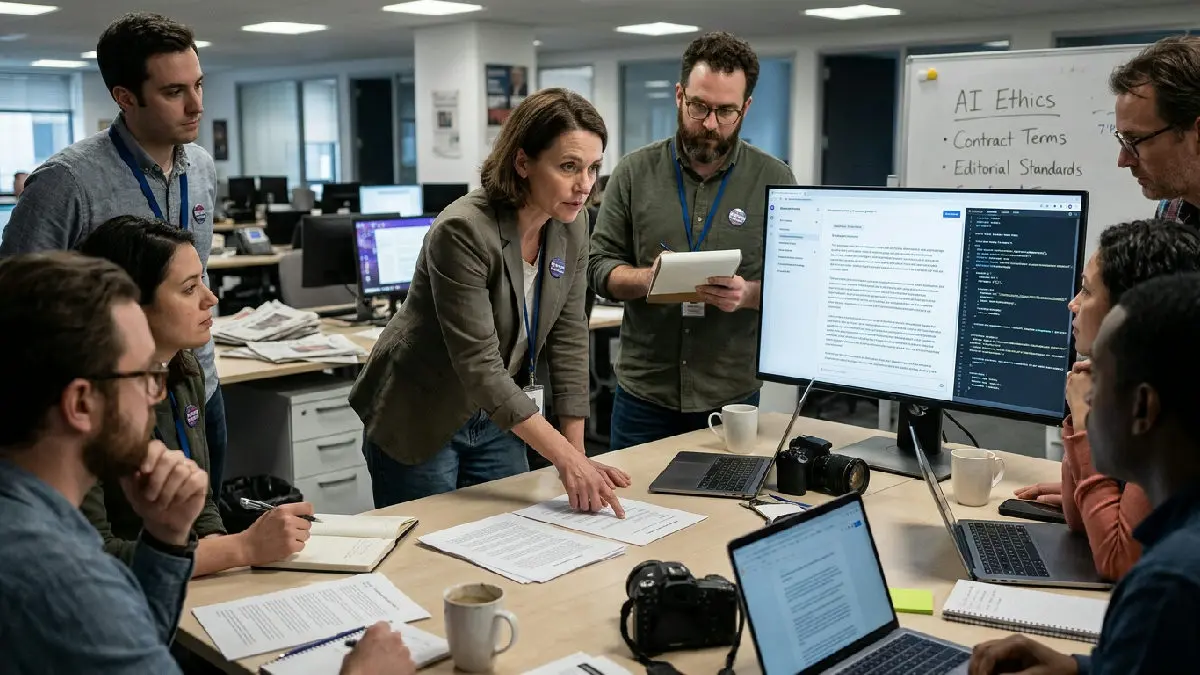
The rise of artificial intelligence (AI) brings new challenges to newsrooms worldwide, faced by trade unions in the United States, Europe, and Asia. Although current data from the Reuters Institute show that two-thirds of media managers have not yet resorted to layoffs due to AI, tensions between publishing management and journalists are growing. Unions are now trying to ensure that technology does not replace human work and does not undermine the professional integrity of journalists.
While the direct replacement of editors by machines is currently marginal, the first signs of change are already appearing. An example is the Associated Press, which this month offered severance pay to more than 120 employees at a time when it is announcing a strategic shift towards AI and video. A similar situation provoked resistance in the American newspapers Miami Herald, The Sacramento Bee, and The Kansas City Star. Journalists there filed a complaint against McClatchy for implementing a tool that automatically generates article summaries and video scripts without the explicit consent of the authors.
Our managers described it as an experiment. We replied that our credibility is the guinea pig in this case,” said Ariane Lange, an investigative reporter for the Sacramento Bee.
In addition to the threat of job loss, the debate is shifting to issues of occupational hygiene and ethics. Tony Winton from the News Media Guild warns of the risk of AI “hallucinations,” i.e., fabricating facts. If a specific journalist is credited with such a text, an algorithm error directly threatens their reputation. Unions are therefore demanding in collective agreements not only prohibitions on layoffs due to automation but also the obligation to consult the newsroom on every new deployment of AI tools.
Conflicts are not avoided in Europe either. In Italy, the main journalists' union called a two-day strike after publishers refused to adopt basic rules for the use of artificial intelligence. New York Times editors, meanwhile, criticize management for the existing AI standards being too vague and inadequate for maintaining editorial quality.
The management of Politico also chose a problematic approach, which, according to union leader Ariel Wittenberg, violated the contract by deploying AI to generate news from political conventions without prior notice. The arbitrator subsequently confirmed that management erred by ignoring the clause on the necessity of human oversight and adherence to ethical standards. For unions worldwide, AI is thus becoming a key issue that defines the future of labor law in the media.