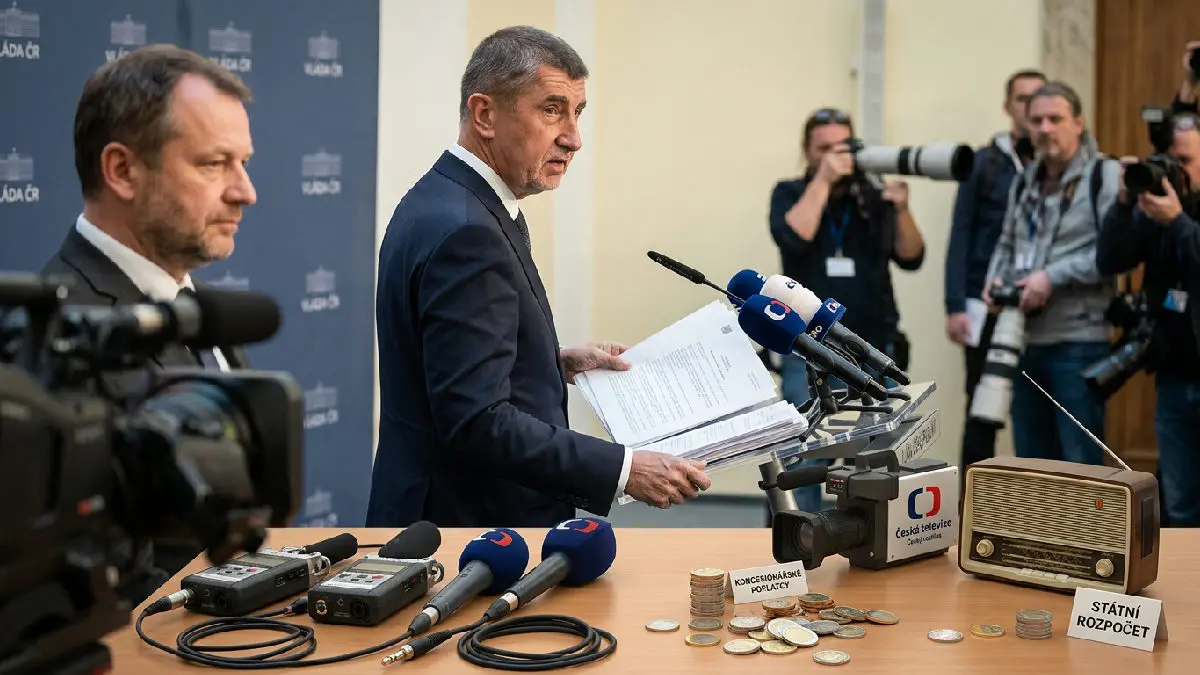
Prime Minister Andrej Babiš's government approved a fundamental amendment to the law changing the system of financing public service media at its Monday meeting. According to the proposal submitted by Culture Minister Oto Klempíř (Motoristé sobě), license fees will be completely abolished. Czech Television (ČT) and Czech Radio (ČRo) will now be directly financed from the state budget, with the total allocated amount expected to be approximately 7.8 billion crowns.
The new budget allocation means a significant drop in revenue for both institutions. Czech Television should receive 5.74 billion crowns, representing a year-on-year decrease of roughly one billion. Czech Radio will receive 2.065 billion crowns, which is 350 million less than this year. Minister Klempíř stated that the legislation provides for valorization of these amounts only if accumulated inflation exceeds 10 percent. According to the minister, the budget cut is intended to create “greater pressure on media quality.”
“Both institutions showed no interest in saving money. We will certainly collect it through EET 2.0,” stated Prime Minister Andrej Babiš in connection with the new funding model from the state treasury.
Despite the radical change in the economic model, the Minister of Culture declared that other aspects of the functioning and independence of both media remain untouched. Klempíř also stated that he had managed to address all comments on the proposal and expects the management of both institutions to ensure standard operations even with limited financial resources. Criticism from the opposition or the professional public has not yet been fully suppressed by the government's statements.
The change in funding comes at a time when the state budget has long been in deficit. However, the government believes that more efficient tax collection will provide the necessary funds. The submitted amendment now moves into the legislative process in the Chamber of Deputies, where a heated debate is expected on the long-term stability and political independence of public service media when directly linked to the state budget.