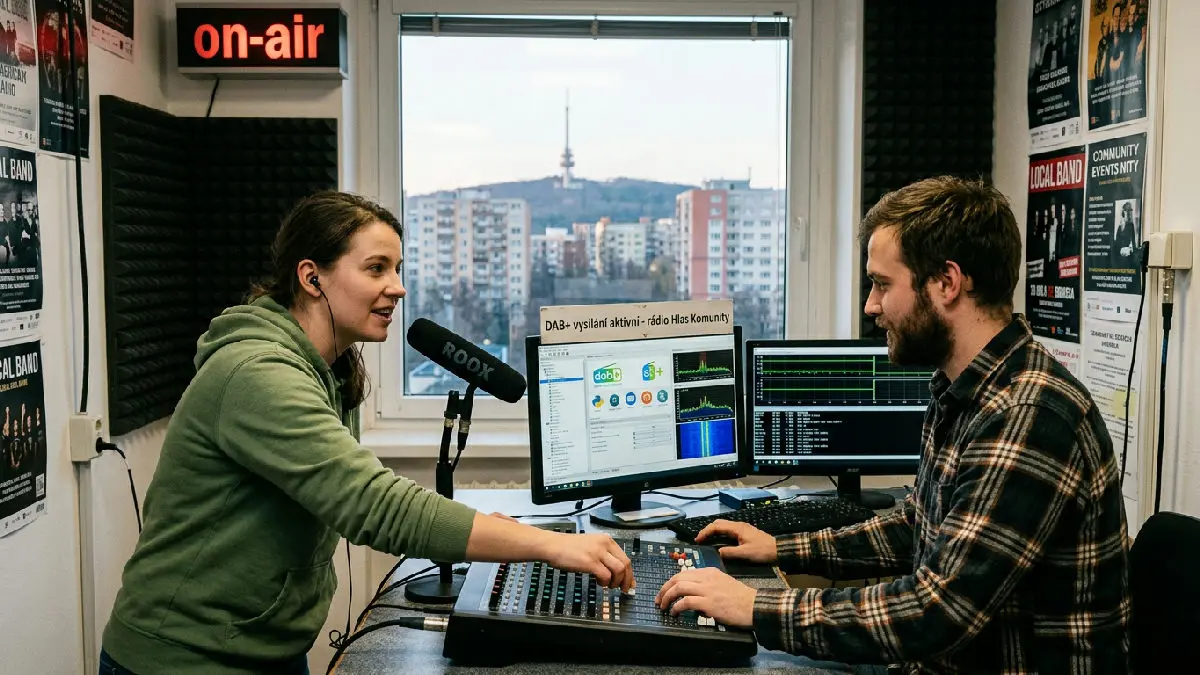
With listeners increasingly transitioning to digital reception, smaller radio broadcasters also need a platform to be accessible. The concept of so-called small-scale DAB+ digital broadcasting offers a solution.
Governments and regulators in many countries recognize the importance of including local and community services in DAB+ broadcasting. The goal is to maintain the diversity and mixed ecology that exists on analog platforms. The necessary frequency spectrum is allocated for this purpose.
Small-scale DAB technology is based on software-defined radio (SDR). It simplifies the transmission infrastructure by emulating all network elements, such as source encoding, multiplexing, and modulation, in a software package. This can be run on off-the-shelf computer hardware. Significant cost savings in distribution are achieved by using internet streams for both DAB+ source encoding and feeding transmitters.
Almost all operators of small-scale DAB networks today use the open-source platform Opendigitalradio. Its open source code provides a flexible starting point for further innovation. The platform is already considered mature enough for deployment in larger networks, for example, it is used in Switzerland to provide nationwide broadcasting layers. The source code is managed by the Swiss company digris AG, which operates DAB+ networks in a growing number of European countries.
Small-scale DAB is used in many countries, including Belgium, the Netherlands, Germany, and Switzerland. In the United Kingdom, media regulator Ofcom is currently licensing approximately 200 small-scale multiplexes. By the end of June 2025, 74 of them were in operation, carrying a total of approximately 600 radio services.