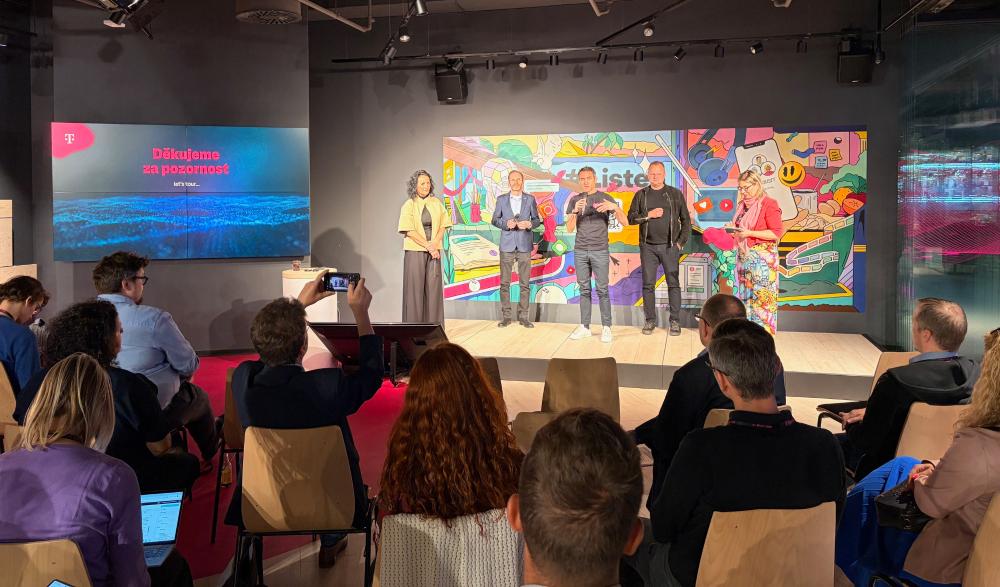
Operator T-Mobile showcased technology solutions built on the 5G Standalone (5G SA) architecture at the Magenta Experience Centre in Prague. The event, named Technology Innovations Day 2026, demonstrated that the new generation of networks no longer serves merely as a concept for the future, but forms the foundation for specific industrial and emergency applications. The main benefits of 5G SA compared to previous versions are lower latency, higher security thanks to SUCI encryption, and the ability to segment the network (slicing).
Among the most prominent demonstrations was the use of 5G SA for television broadcasting. Technology from LiveU allows high-quality live image transmission without the need for satellite trucks. The system utilizes so-called bonding, i.e., combining multiple data streams (4G, 5G, satellite) into one stable channel. If one of the connections drops, data is automatically redirected elsewhere, ensuring smooth transmission even in areas with weaker signals.
“The solutions presented have one thing in common – they are not concepts for the future, but specific use cases that are working on our 5G SA network today. Our goal is to bring technology closer to people and explain that 5G SA is not just a faster network, but a complex infrastructure,” said Carlos Fernandes, Technology Director of T-Mobile Czech Republic.
In the area of security and industry, the operator demonstrated the deployment of robotic dogs and drones. These robots, equipped with thermal cameras and IoT sensors, can autonomously perform inspections in hazardous environments, detect gas leaks, or map inaccessible objects in real-time via a cloud platform. A significant advance is also represented by the telesurgery project, on which T-Mobile cooperates with military hospitals in Brno and Prague. It allows a remote expert to assist in an operation through a 3D image transmitted with minimal delay.
Significant space was also given to artificial intelligence (AI) and augmented reality (AR). Smart glasses offering real-time translation for 89 languages or virtual control panels for machine management were on display. The visionary part concluded with a presentation by the Deutsche Telekom research team focused on quantum teleportation. This project enables the transmission of quantum states over conventional optical fibers over distances of up to 30 kilometers, which will enable the interconnection of quantum computers into unified networks in the future.
In addition to end-user applications, T-Mobile also focused on infrastructure. It introduced the “Towers in the Sky” concept, which uses autonomous flying platforms to temporarily boost signal in areas with high concentrations of people or in the event of terrestrial transmitter outages. The operator also emphasized the energy efficiency of the new network core, which contributes to achieving sustainability goals.