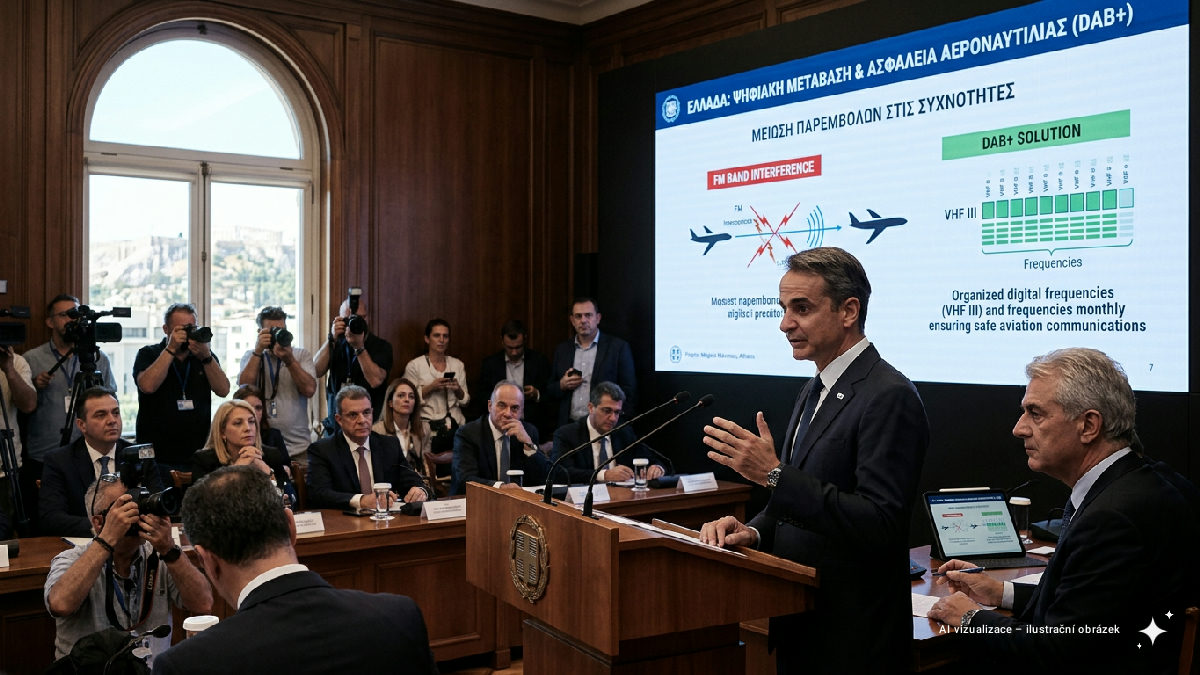
Debate over the future of the airwaves has reignited at the Greek government headquarters. Prime Minister Kyriakos Mitsotakis and the president of public broadcaster ERT, Giannis Papadopoulos, have already presented the possibilities of DAB+ digital radio to resolve longstanding chaos in licensing and technical broadcasting parameters. This step comes as the Deputy Minister to the Prime Minister’s team meets with representatives from relevant authorities to draft the final radio licensing bill.
The primary driver behind these discussions is not merely digitalization, but above all aviation safety. Air traffic safety is directly threatened by the current state of the FM band, which suffers from signal interference. Authorities are therefore striving to define the maximum number of stations that can broadcast safely. Although the existing limit for private broadcasters is set at 35 stations, in practice this number is routinely exceeded due to a series of rulings by the National Council for Radio and Television (ESR), piling pressure onto congested frequencies.
The new DAB+ digital platform will enable legal broadcasting for more than 150 radio stations across Greece without mutual interference.
New Mapping of the Radio Market
The government has already taken initial steps to remedy the chaotic situation by developing a dedicated digital application. It contains a comprehensive database of radio stations and their transmission sites, regardless of whether they currently hold a valid license. This registry will serve as the cornerstone for drafting a new Frequency Map, establishing the rules for future broadcasting rights allocation.
External entities and expert committees are also participating in the project's implementation. The state will pay €37,200 to Vitalis Stef Monoprosopi IKE for consulting services in this domain. At the same time, a specialized committee has been established focusing exclusively on DAB+ digital broadcasting issues. This system utilizes the VHF frequency band, previously vacated following the switch-off of analogue television.
Notably, the technical blueprint for nationwide digital coverage is not entirely new. The Ministry of Digital Governance has access to a project drafted during the SYRIZA government led by Professor Christos Kapsalis. This plan was officially published in the Government Gazette back in January 2018 under reference FEK 54/B/18. 01. 2018 and serves as technical guidance for the current measures.
The state is investing €37,200 in consulting services to assist in the transition to the modern DAB+ digital standard.
Simulcast Model as a Solution
The key to accommodating all market players is expected to be a model already being tested by public broadcaster ERT in the Attica region: simulcasting on both FM and DAB+. This approach addresses the issue of limited analogue capacity. Since only 35 privileged private stations can operate safely on the FM band in Attica, other applicants would be granted space on digital.
Technical parameters and advantages of transitioning to DAB+ technology include:
Use of VHF band — efficient utilization of frequencies freed up after TV digitalization.
High channel capacity — each individual channel in the VHF band can accommodate 10 to 24 stations.
Nationwide ambitions — the technology paves the way for nationwide stations as well as numerous local media outlets.
End of interference — digital transmission eliminates signal overlap plaguing current FM broadcasting.
The Role of Regulators and Next Steps
The broadcasting landscape is closely tied to the operations of the National Council for Radio and Television (ESR), which is currently undergoing personnel changes. Additionally, the Council will now have to oversee social media regulations concerning minors, expanding its remit in the digital space.
National Council for Radio and Television (ESR)
ERT currently operates digital broadcasts in the Attica basin and has prepared a detailed network rollout plan for the rest of Greece. The success of this pilot is expected to dictate the pace at which private broadcasters migrate to the new system. Broadcasters that fall short in scoring for the limited FM slots will be guaranteed a proper license on the digital platform.
An official date for launching the new licensing process has not yet been set, but the frequency of government team meetings indicates the bill could be tabled for a vote in the coming months. An open question remains how quickly the market can absorb dual-broadcasting costs and whether listeners will upgrade their receivers in time to modern sets supporting DAB+.