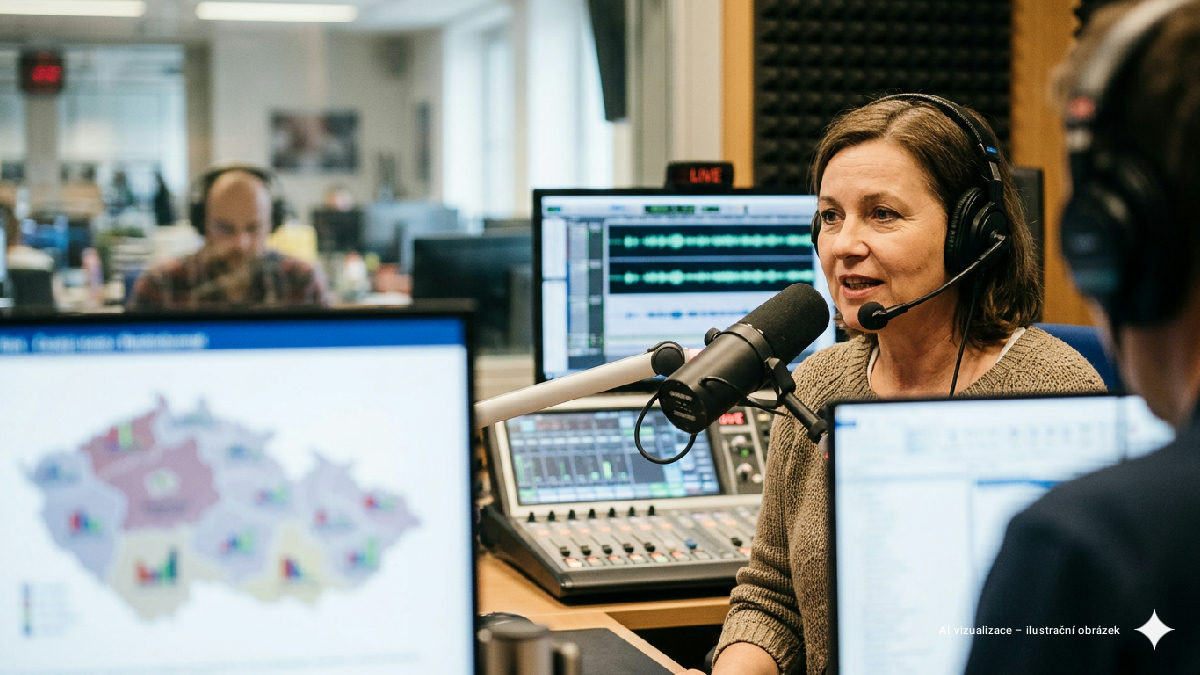
These are the results of the RADIOPROJEKT survey for the period from January 1 to June 30, 2026, prepared by STEM/MARK and MEDIAN. The data works, among other things, with the indicator "yesterday's listenership," meaning the estimated number of people who listened to a given station on the previous day.
Radiožurnál first, but Evropa 2 is close behind
In the nationwide market, first place belongs to ČRo Radiožurnál, which achieves a daily listenership of 745,000 listeners. The difference compared to second-placed Evropa 2 is not dramatic – it reaches 673,000 people daily.
The imaginary bronze medal goes to Rádio Impuls with 600,000 listeners, closely followed by Rádio Blaník with 558,000. The top five is rounded out by Frekvence 1, which, according to Radioprojekt, is listened to by 458,000 people daily.
This top five illustrates how concentrated the peak of the Czech radio market is. The difference between the first-placed Radiožurnál and fifth-placed Frekvence 1 is just under 300,000 daily listeners. Beyond the top five, there's a more significant gap: ČRo Dvojka has 300,000 listeners and ČRo Plus 169,000.
Interestingly, there's also a long "tail" of smaller nationwide projects. Radiožurnál Sport reports 86,000, Vltava 56,000, Rádio Prostor 41,000, and Rádio HEY 39,000 listeners. Český Blaník has 35,000, Rádio Oldies 31,000, and Rock Radio Stage 21,000.
Kiss is the strongest supra-regional brand
Supra-regional stations represent a separate league. The ranking here is very interesting.
Rádio Kiss reaches 470,000 daily listeners, and its reach is even higher than that of the fifth strongest nationwide station, Frekvence 1. Second place among supra-regional radios is held by Hitrádio Total+ with 401,000 listeners.
This is followed by a strong rock duo – Rádio Beat with 269,000 and Rock Rádio with 247,000 listeners. Country Rádio reaches 227,000 people and Fajn Radio 114,000.
These numbers clearly show that dividing the market into "nationwide" and "regional" does not automatically mean dividing it into large and small players. Some supra-regional brands have an audience comparable to the largest national radios.
Čas Rock is the regional leader
An even more diverse situation arises among regional stations. In their TOP 10, Radio Čas Rock appears in first place with 102,000 daily listeners.
It is followed by Rádio Krokodýl and Hitrádio Orion, both with 85,000 listeners. Signál Rádio has 83,000 and ČRo Brno 66,000. Also making it into the top ten are Hitrádio Černá Hora, Hitrádio FM Plus, ČRo Střední Čechy, RockZone, and Rádio Jih.
And it is precisely the regional data that is perhaps the most interesting part of the entire Radioprojekt. It shows that the Czech Republic actually does not have one radio market, but a number of very different regional markets.
Prague listens differently than the rest of the republic
Prague is a typical example. Radiožurnál reaches 132,000 listeners daily here and also leads with a share of 15.3%. In second place by daily reach, however, is ČRo Plus with an exceptionally strong 84,000 listeners. This is followed by Rádio Beat with 57,000, Blaník with 55,000, and ČRo Dvojka with 53,000.
Evropa 2, which is the second strongest radio nationwide, has 44,000 listeners in Prague according to daily reach. Prague thus appears to be a significantly more specific and fragmented radio market than many other regions.
Central Bohemia belongs to Blaník, South Moravia to Evropa 2
In the Central Bohemian Region, the situation is completely different. Here, Rádio Blaník reigns with 102,000 daily listeners, followed by KISS with 88,000 and Radiožurnál with 87,000. Evropa 2 reaches 75,000 listeners here and Impuls 68,000.
The South Moravian Region, in turn, has its winner in Evropa 2. It reaches 108,000 people daily here, Radiožurnál 98,000, and the local Rádio Krokodýl holds an exceptionally strong position with 66,000 listeners.
This is important news for the entire radio market: a strong local brand can play a very significant role in the region, even in an era of nationwide networks, streaming, and digital distribution.
In Vysočina, only a thousand listeners separate the top two stations
Vysočina brings a very close battle. According to daily reach, ČRo Radiožurnál is number one here with 53,000 listeners, but Rádio Blaník is practically neck and neck behind it with 52,000.
It is followed by Evropa 2 with 46,000, Rádio Impuls with 37,000, and Rádio Beat with 24,000 listeners. From the perspective of listening share, Blaník is even higher – the Radioprojekt table attributes a 27.7% share to it, while Radiožurnál has 24.4%.
Vysočina thus shows an important difference between the sheer number of people who tune in to a radio during the day and a station's share of total listening time.
Zlín? Rock rules there
One of the most notable regional victories can be found in the Zlín Region. Rock Rádio reaches 57,000 people daily here and achieves a 27.4% share. Second-placed Frekvence 1 has 41,000 listeners, third Evropa 2 36,000, and Radiožurnál 31,000.
It's a beautiful example of how dramatically the local radio map can differ from the nationwide ranking.
Similar regional strength can also be seen in the Liberec Region, where Rádio Blaník leads with 52,000 listeners and a 27.6% share, while in the Hradec Králové Region, Evropa 2 is first according to daily reach with 47,000, and Rádio Kiss and Hitrádio Černá Hora share second place with 39,000 each.
Radio remains a surprisingly local medium
The results of Radioprojekt for the first half of 2026 thus tell a more interesting story than just the battle between Radiožurnál and Evropa 2.
Nationwide, the top is relatively clear: Radiožurnál – Evropa 2 – Impuls – Blaník – Frekvence 1. However, once the republic is divided by regions, the order changes dramatically.
In Prague, ČRo Plus and Rádio Beat are exceptionally strong. In the Central Bohemian Region, Blaník dominates. In South Moravia, Krokodýl can significantly impact the battle of the biggest players. In the northeast, Kiss and Hitrádio Černá Hora hold strong positions. In the Zlín Region, Rock Rádio wins.
And it is precisely in this that one of the most interesting messages of the current Radioprojekt may lie: radio, even in 2026, is still a surprisingly regional medium.
While nationwide brands garner hundreds of thousands of listeners, people's preferences differ significantly across various parts of the republic. For radio operators and advertisers, it is therefore increasingly important not only to ask "how many people listen to the station nationwide?" but also "where do they listen to it and how strong is it there?"
The Czech airwaves do not have one universal winner. They have national champions – and alongside them, many very strong regional players.