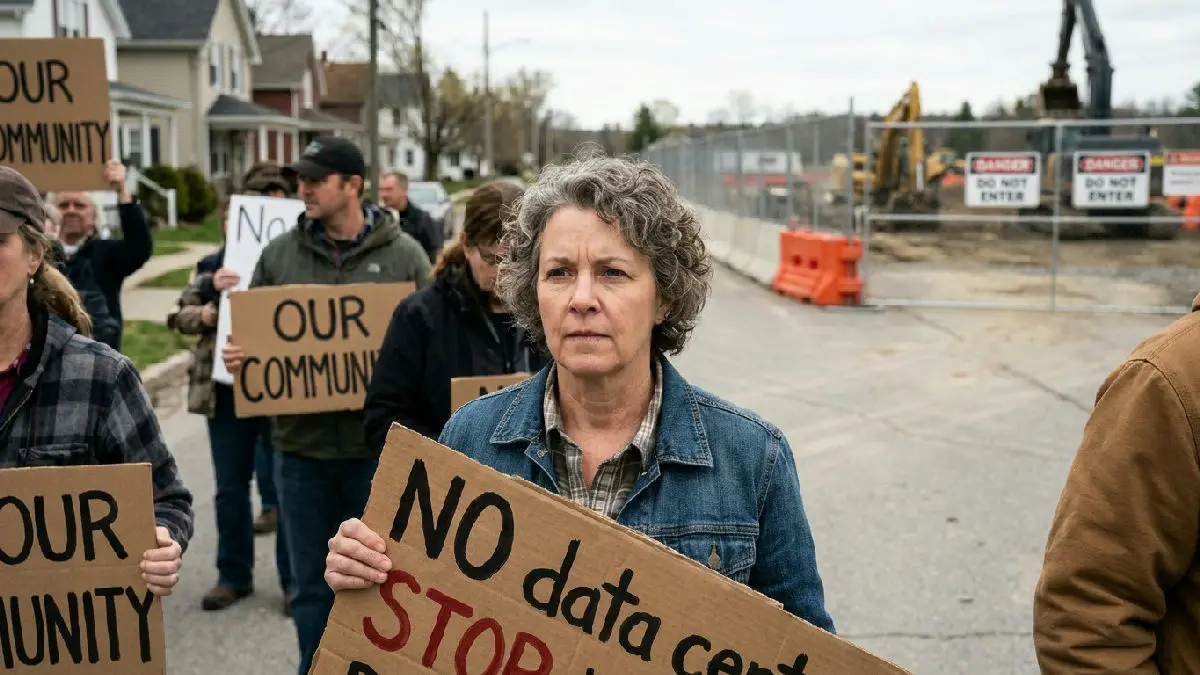
American public opposition to data center construction is becoming a new tool in information warfare. According to recent Gallup polls, 71 percent of Americans oppose data centers near their homes. This figure is significantly higher than for nuclear power plants, which 53 percent of respondents would not want in their neighborhood. Foreign actors are now massively exploiting this natural distrust to destabilize society.
A report by The New York Times notes that primarily China and Russia are using artificial intelligence to deepen societal divisions. According to McKenzie Sadeghi, a senior analyst at Alethea, it is an ideal topic for manipulators.
“It’s a topic that is locally sensitive in all 50 states, it’s new, and it builds on pre-existing sentiments against China, taxes, and the selling off of America,”
Sadeghi explains the mechanism of attacks.
Fake Comics and Coordinated Groups
The campaign uses a wide range of tools, from sophisticated deepfake videos to seemingly innocent local content. Revealed cases include a fake comic created by ChatGPT in China, which purported to be authentic print material in Maryland. Russian propaganda, meanwhile, targeted a US data center in Armenia through manipulative videos.
Another discovered strategy involves operators from Bangladesh who manage Facebook groups targeting residents of all US states. In these communities, they mix ordinary posts about life in the region with content directed against technology and data centers. This approach shows how easily automated tools can be used to target specific audiences regardless of geographical boundaries.
A Challenge for Communications Experts
Experts warn that the line between genuine public opinion and a coordinated attack is blurring. The strategy of foreign powers is not to invent problems, but to artificially amplify existing dissatisfaction. Operators of critical infrastructure and communication experts thus face the challenge of distinguishing authentic criticism from the inauthentic behavior of bots and troll farms.
It is recommended to use advanced tools for disinformation detection.
Closer cooperation with social media operators is necessary to delete fake accounts.
The key is not to confuse propaganda with genuine citizen concerns, which must be addressed.
Even if the topic is artificially fueled by foreign intelligence, experts emphasize that the essence of the problem cannot be ignored. Residents' genuine concerns about the environmental impact of construction or energy consumption remain a legitimate issue that requires transparent communication from both the state and private investors.