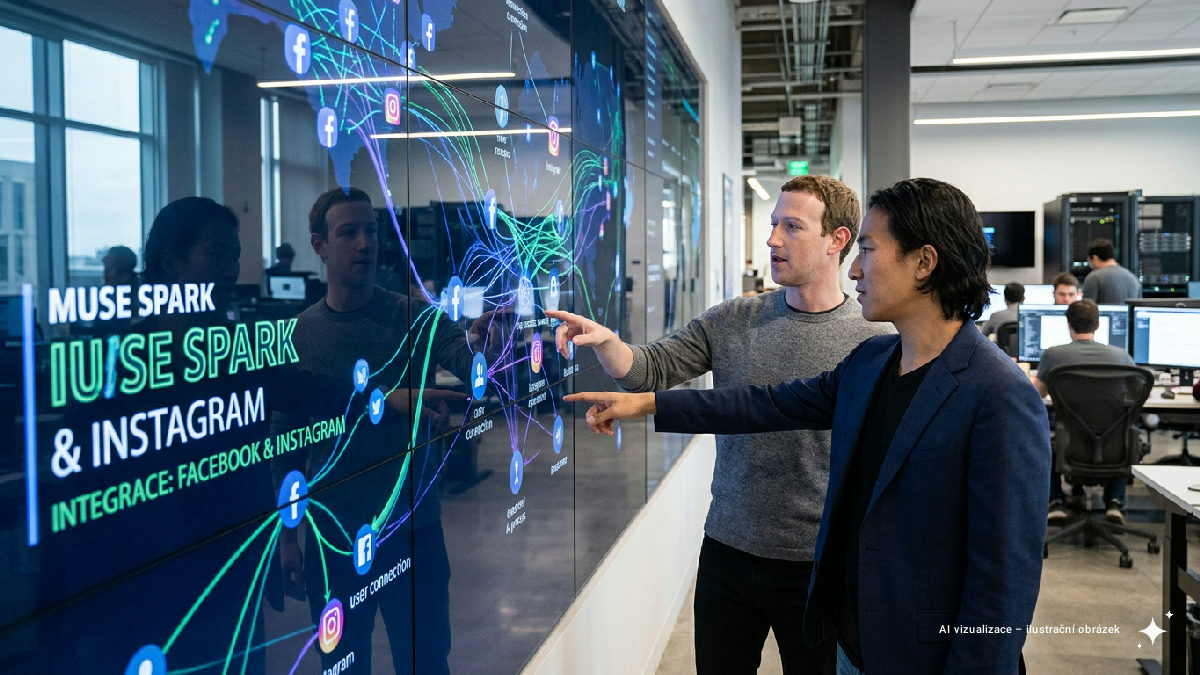
A year ago, Mark Zuckerberg was accompanied by considerable frustration. The Llama 4 model did not meet expectations, and Meta faced criticism for manipulating benchmark tests. The head of the tech giant therefore opted for a radical change of course: closed development, multi-billion dollar investments, and a new laboratory focused on achieving superintelligence. The result is the Muse Spark model, which was introduced on Wednesday, April 8, 2026, and according to initial independent analyses, finally brings Meta back to the absolute global elite.
Strategy Change and Billion-Dollar Transfer
The key to the turnaround was abandoning a purely open-source approach. Zuckerberg decided to build a closed lab and put Alexander Wang at its helm. This acclaimed expert, who co-founded Scale AI at just nineteen years old, joined the team as part of a massive transaction. Meta acquired a 49% stake in Scale AI for $14.3 billion, thereby securing the expertise needed to train next-generation models.
Meta acquired a 49% stake in Scale AI for $14.3 billion to catch up with competitors under the leadership of Alexander Wang.
While the previous Llama 4 Maverick model failed in Artificial Analysis tests with a mere 18 points, the new Muse Spark achieved 52 points. This leap places Meta just behind market leaders such as Gemini 3.1 Pro (57 points), GPT-5.4 (57 points), and Claude Opus 4.6 (53 points). Although Meta admits it is an intentionally smaller and faster model for functional verification, the results indicate that the technological gap has closed.
Integration into Billion-User Applications
Meta's greatest weapon is not the model's performance itself, but its availability. Muse Spark will not rely solely on a standalone interface but will become an integral part of an ecosystem used by billions of people daily. In the coming weeks, the tool will appear directly in WhatsApp, Instagram, Facebook, and Messenger applications, and even in Ray-Ban smart glasses. The goal is for users not to have to switch to external applications like ChatGPT for AI assistance.
Users will get specific features directly within social networks:
- Instagram — ability to ask AI about clothing directly on influencer posts.
- Facebook — searching for travel tips based on real user experiences within their social bubble.
- WhatsApp — instant photo analysis, such as explaining a medication leaflet during a conversation.
- Ray-Ban — advanced image analysis for real-time interpretation of the surrounding world.
Muse Spark will be integrated directly into Facebook, Instagram, and WhatsApp, so users don't have to open other apps.
Three Modes and Medical First
The Muse Spark model operates in three specific modes according to task complexity. Instant mode serves for immediate answers, while Thinking mode takes time for deeper analysis. The most advanced Contemplating mode then activates multiple AI agents simultaneously to assess the problem from different perspectives. Although the model still lags in programming, it achieved a success rate of 42.8% in medical tests, surpassing competing GPT-5.4 and Gemini.
“AI not only answers your questions but truly understands your world because it’s built on it,”
Artificial Intelligence Enters Czech State Administration
While Meta targets global social interactions, the Czech public administration is beginning to use AI for purely practical purposes. The Ministry of Finance, under Alena Schillerová, and the Financial Administration have introduced a beta version of an application for filling out tax declarations. The project, whose development cost 3 million CZK including infrastructure, aims to ease administrative burdens for people with employment income and students.
The application for taxpayers works in several steps:
- Upload documents — the user uploads PDFs or photos of income certificates.
- Data extraction — the system uses AI to identify relevant data and fill in form fields.
- XML generation — the result is a file ready for the Moje daně portal or data box.
- Review and submission — the user must check the data, as they bear full responsibility for its accuracy.
Despite technological progress, the Financial Administration strongly warns that the application is not connected to state registries and serves solely as an assistant. Data remains in a secure environment and is accessible only to the user throughout the processing. Responsibility for errors in the declaration remains with the people, not the software.
Timeline and Future
Czech users will get both innovations soon. While the tax application can be used for current submissions (electronically until May 4, 2026), the full version of the Muse Spark model will arrive in the Czech Republic during the spring. Meta plans to gradually release advanced modes and broader integration options into its platforms for other countries in the coming weeks.
In the future, the Financial Administration plans to expand AI services for entrepreneurs and deepen integration with the Moje daně portal, for example, for a unified monthly employer report. The decisive factor will be feedback from the current pilot operation, which the ministry considers a key test of the user-friendliness of state digital services.