
You've finished a great article, it took you several hours to write, but now you've been staring blankly at the empty headline line for twenty minutes. You come up with five variants, but you're not sure if any will grab attention or, conversely, get lost among dozens of others. This is where targeted analysis, now achievable even with artificial intelligence, can help.
What it's all about
Headline Tester and similar tools are essentially specialized language models trained on vast amounts of data from successful and unsuccessful headlines. Unlike general chatbots, they don't try to generate text but to analyze it. You input your variant, and the tool analyzes it within seconds according to several key metrics. Typically, it assesses the overall "clickability" score, emotional charge (is the headline more positive, negative, or neutral?), comprehensibility, and length.
The main benefit is not that AI tells you "this is the winner." Its strength lies in providing a data-driven perspective on your creative ideas. It addresses a specific editorial or PR uncertainty problem – it helps quantify the feeling of "this sounds good" and uncovers hidden weaknesses. For example, a headline you find clever might be confusing for the average reader. The tool won't tell you what to write, but it will show you how your words might affect an audience that doesn't share your context.
Imagine you have the headline "New EU regulation changes cookie rules." AI might show you that while it's understandable, it's emotionally flat and has a low engagement score. You then test the variant "End of annoying banners? What the new EU cookie regulation means for you" and find that it has a much stronger emotional footprint and uses "power words" without slipping into clickbait. It's rapid feedback that previously required costly A/B testing.
Trends that support this
The massive expansion of AI tools for text work is no coincidence. It responds to several fundamental changes in the media and communication environment that make optimizing headline work not a luxury, but a necessity.
Content deluge and the battle for attention. An enormous amount of articles, videos, and statuses are created every minute. The headline is often the only chance to stand out in this information noise and get users to click.
Pressure for measurable results. The era when "editorial instinct" was enough is slowly ending. Managers and clients want to see data. Headline testing tools provide at least basic data for decision-making and justifying the chosen approach.
Audience fragmentation and clickbait fatigue. Readers are increasingly sensitive to manipulative and exaggerated headlines. An AI analyzer helps strike a balance between attractiveness and trustworthiness, which is crucial for maintaining a loyal audience.
Integration of AI into editorial processes. Artificial intelligence is no longer a toy for enthusiasts and is becoming a common part of editorial systems and workflows. Headline testing is one of the first, easily implementable steps.
When to use it and when not to
Like any tool, the Headline Tester has its ideal use cases, but also situations where its deployment can be counterproductive.
It helps with the final selection among several ready-made headline variants.
It helps for quick headline optimization for different platforms – more serious for LinkedIn, more emotional for Facebook.
It helps as a training tool for junior editors and copywriters to understand the principles of a good headline.
It helps break creative blocks – analyzing existing ideas can reveal a new direction.
A bad tool for a bad problem, if you are trying to evaluate highly specialized, technical, or artistic text whose context and terminology AI does not understand.
A bad tool for a bad problem, when you use it as a substitute for knowing your target audience. AI evaluates the general population, not your specific readers.
A bad tool for a bad problem, if you blindly follow the highest score and ignore your brand or media's tonality.
Step by step
Prepare multiple variants. Never test just one headline. Prepare at least 3-5 different versions – one factual, one with a question, one with a number, one slightly provocative.
Insert headlines into the analyzer. Most tools allow comparing multiple variants at once. Insert all prepared options and start the analysis.
Focus on the overall score first. See which headlines achieved the best overall rating. Take this as an initial filter, not a final verdict.
Examine the emotional profile. Does the headline's emotional charge match the article's content? A headline for an economic recession analysis should not have a strongly positive sentiment. The tool will show you what emotions the words are likely to evoke.
Evaluate comprehensibility and length. Is the headline easy to read and understand within seconds? Is it too long to display on mobile devices or in search results? AI often also offers a readability metric.
Make the final selection with human judgment. Data from AI is just one input. Combine it with knowledge of your brand, audience, and ethical principles. Sometimes the best choice is to combine elements from the two highest-scoring variants.
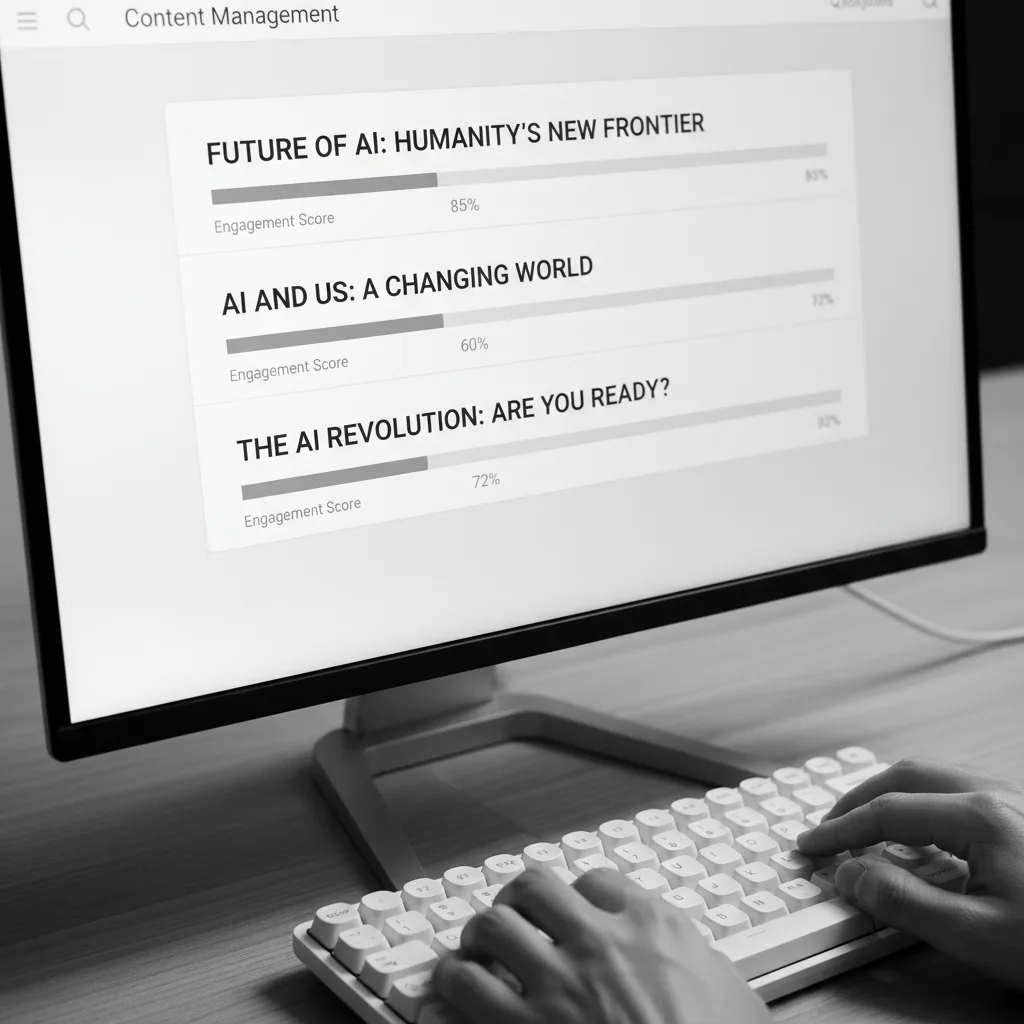
AI compares headline variants – emotions, comprehensibility, clickability.
How to read the output
The most important rule is: don't take numerical scores as absolute truth. A score of 85/100 doesn't mean the headline is objectively perfect. It is merely a prediction based on statistical patterns. Always ask why the tool arrived at a given rating. Look at the score breakdown – is it high because of strong words or because of the correct length? Is it low because of negative sentiment, which might be desirable for the given topic?
A typical pitfall is the pursuit of positive sentiment. For news about tragedies, problems, or critical analyses, a neutral or slightly negative tone is, on the contrary, a sign of seriousness. AI lacks context in this regard. Similarly, recommendations for "power words" – words like "incredible," "shocking," or "secret" – can increase the score, but they also push the headline to the edge of clickbait and can damage the credibility of your media.
Read the output from Headline Tester as a recommendation from a junior but extremely well-read colleague. They have an overview of what generally works but do not know the specifics of your project, your target audience, or your brand's long-term strategy. Their advice is valuable, but the final decision must remain in your hands.
Common mistakes
Blind pursuit of the highest score. The user ignores the context of the article and the media's tonality just to achieve the highest possible number. The result is a headline that doesn't align with the rest of the content.
Testing a single variant. Inserting only one headline into the tool and expecting AI to "fix" it is inefficient. The tool's power lies in comparison.
Ignoring the target audience. AI doesn't know if you're writing for financial directors or teenagers on TikTok. A headline with a high general score can completely fail with your specific group.
Over-reliance on SEO recommendations. Some tools suggest adding keywords. This can lead to convoluted and unreadable headlines that might please a bot but deter a human.
Confusing analysis with creation. This tool is not for inventing headlines from scratch. Its purpose is to analyze and compare human creativity, not to replace it.
AI is inspiration, not dogma
It is crucial to realize that AI tools like Headline Tester are merely advisors, not editors-in-chief. They provide a valuable data perspective and can reveal blind spots in our own thinking. They work great as a sparring partner who challenges our initial ideas and forces us to think about alternatives. However, they should under no circumstances take over editorial responsibility.
Blind trust in AI scores leads to uniformity and a loss of originality. If everyone optimizes headlines using the same metrics, all headlines will sound similar. A human editor, journalist, or PR professional injects not only words into a headline but also knowledge of context, an ethical dimension, and a feel for language and brand. This human judgment is irreplaceable and remains the cornerstone of quality and trustworthy communication. AI is a tool for more informed decision-making, not for its automation.
What's next
Mastering the headline is the first step. Once you are confident that your "shop window" is attractive and honest, it's time to focus on the content itself. In future installments of our "How-to" series, we will look at tools that help you summarize long texts, verify facts, or generate engaging visual assets. By combining these helpers, you can streamline routine work and gain more time for what is most important – creating quality content.