In recent years, the Internet of Things (IoT) has transformed from a tool for simple data collection into complex systems for automation and strategic management. České Radiokomunikace (CRA) is responding to this trend by developing its IoT platform, which no longer serves merely as a communication channel, but as an open ecosystem connecting hardware, connectivity, and data analytics.
The foundation of CRA's infrastructure remains the national LoRaWAN network, which is characterized by its low energy consumption and ability to penetrate signal into challenging industrial locations or underground areas. This technology allows end devices to operate on batteries for several years, significantly reducing operating costs. For more data-intensive, real-time operations, however, the company also utilizes NB-IoT or LTE standards, ensuring technological neutrality through its Multitech Cloud platform.
“CRA IoT is not an isolated service, but a scalable platform that connects connectivity, hardware, and application superstructures into a single functional unit.”
A prominent feature in the portfolio are universal industrial controllers with a high degree of protection (IP68). These modules allow for the digitization of older technological equipment that was not originally designed for IoT. Thanks to a combination of analog and digital inputs, it is possible, for example, to convert standard industrial signals into specific physical quantities and then wirelessly transmit them for evaluation.
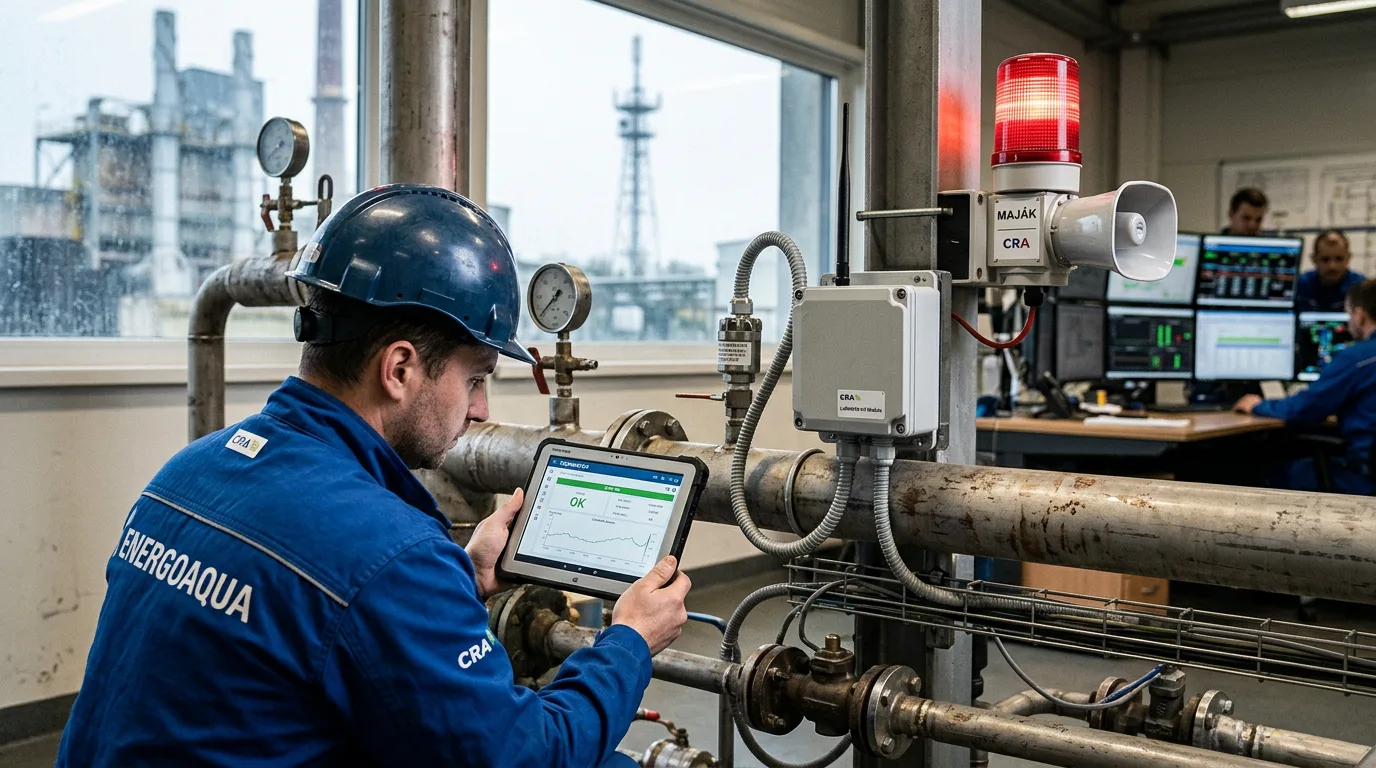
A practical application of this approach is demonstrated by the collaboration with Energoaqua. In a sprawling industrial complex, there was a need to ensure continuous monitoring of pipeline pressure without building expensive cable infrastructure. CRA deployed wireless controllers connected to existing sensors and the TECHWATCH platform for data visualization. The system also includes a warning device "Maják" (Lighthouse), which alerts the control room with sound and light signals in critical situations, independently of the local network.
Current projects are thus moving from simple energy meter readings to advanced predictive maintenance and indoor environment monitoring. According to the company, the goal is to create solutions where data serves as an active management tool, not merely as a basis for retrospective reporting.