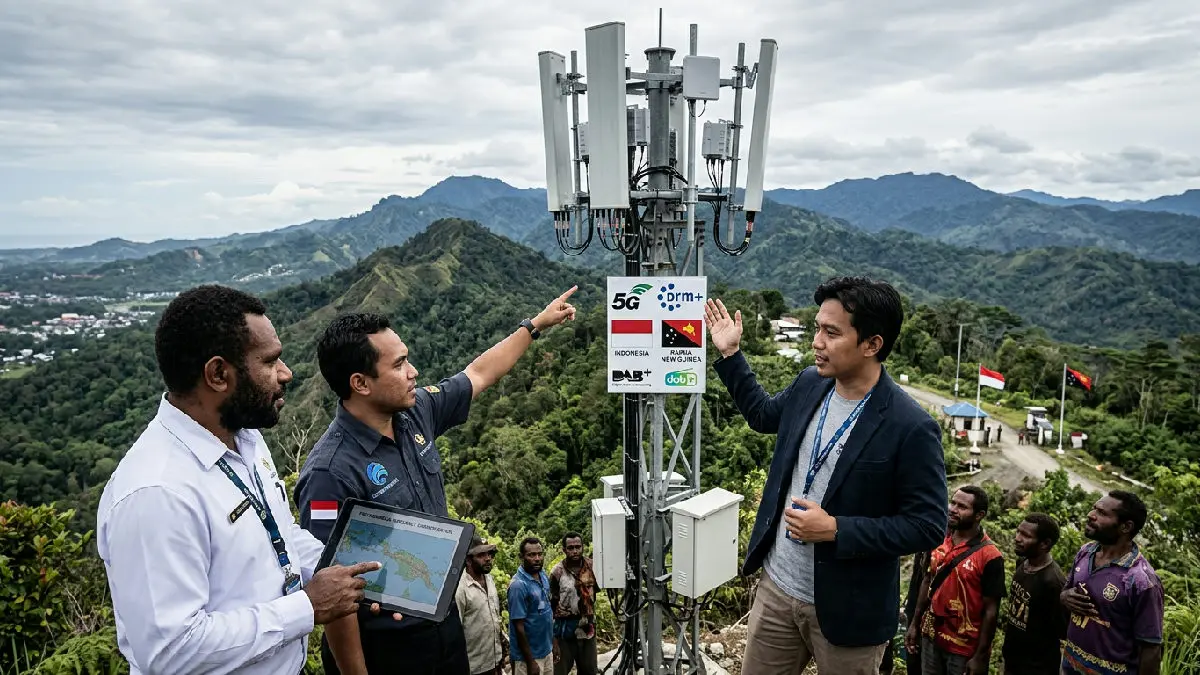
Representatives from Indonesia and Papua New Guinea met in Yogyakarta for the third Technical Coordination Meeting (TCM), with the primary goal of harmonizing radio spectrum in border areas. The discussions, held from May 19 to 21, 2026, addressed the technical issue of signal propagation, which does not respect state borders and causes mutual interference without coordination.
A key agenda item was the synchronization of bands designated for fifth-generation mobile networks and digital radio broadcasting. Both countries confirmed agreement on the use of the 2.6 GHz band for 5G networks. According to Adis Alifiawan from the Indonesian Ministry of Communication and Digital Technology, this step will ensure that infrastructure in border cities such as Jayapura or Merauke is fully compatible with networks across the border.
“The goal is to harmonize spectrum utilization between neighboring countries, because signals do not stop at borders. By sharing frequency plans, we know how our neighbors are using the same spectrum, which acts as a preventive step to avoid interference,” said Alifiawan.
Significant progress was made in the area of digital sound broadcasting (DSB). Papua New Guinea has decided to follow the Indonesian model and simultaneously implement both DRM (Digital Radio Mondiale) and DAB+ standards. This will make it only the second country in the region, after Indonesia, to implement these two platforms in parallel. While DAB+ is effective for urban agglomerations with the capacity to broadcast up to 16 programs from a single transmitter, DRM technology is crucial for covering vast and remote areas due to its range in shortwave and mediumwave bands.
Richard Nepao from the NICTA office confirmed that Papua New Guinea plans pilot projects in Port Moresby and Buka. The priority is primarily the use of digital broadcasting for warning systems against natural disasters. Indonesia currently operates nine DRM transmitters in disaster-prone areas and six DAB transmitters in major cities such as Jakarta and Surabaya.
“Indonesia is piloting receiver projects that can handle both DRM and DAB, which is not common in other countries. We want to collaborate on standardizing these receivers within the Asia-Pacific region,” added Eugene Yerua, a broadcasting planning engineer from NICTA.
In addition to radio and mobile networks, delegates also discussed microwave links (6 GHz) and preparation for the future introduction of digital television in UHF bands. Coordination should ensure signal stability and coverage up to 50 kilometers on both sides of the border, even in the challenging mountainous terrain that divides the two countries.