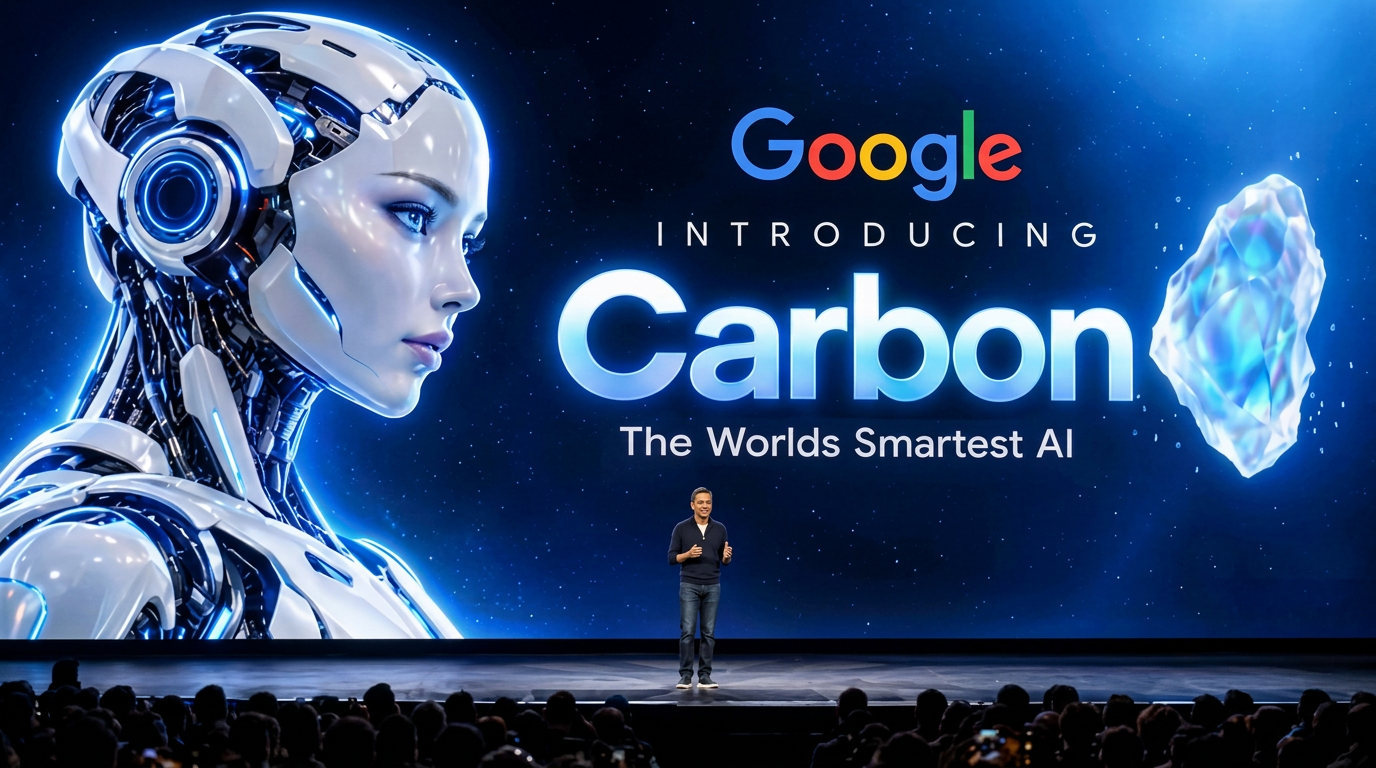
The battle among tech giants for supremacy in artificial intelligence is accelerating. Just two weeks after releasing its previous version, Google has introduced Gemini 4 Carbon, aiming to push the boundaries of programming and cybersecurity. With this move, the company responds to fierce competition from OpenAI and Anthropic, both of which have regularly traded leads across various performance benchmarks in recent months.
The new Carbon release is not merely an incremental update; according to Google's internal data, it represents a substantial step forward. On the prestigious general benchmark AA Index v5.0, the model achieved a score of 59 points, narrowly beating both Claude Opus 5.5 and GPT-6 Astra. Google reports winning nearly all key categories, from scientific computing and mathematics to complex knowledge work, including agentic coding and computer use.
The Gemini 4 Carbon model set a record score of 59 on the AA Index v5.0 benchmark, outperforming rivals Claude Opus 5.5 and GPT-6 Astra.
Dominance in Cyber Defense
While differences between models remain narrow in general evaluations, Gemini 4 Carbon has established a significant lead in cybersecurity. Developers focused on the AI's ability not only to identify threats but also to actively participate in eliminating them. Carbon excels at prioritizing vulnerabilities and fixing their root causes directly in the codebase—a critical capability for security experts.
The model's security architecture was also reinforced against misuse. Google states that Carbon is better equipped to resist prompt injection techniques and curbs the use of shortcuts or logic gaps that could lead to hazardous outcomes. Compared to its predecessor Argon, the new model is twice as successful at generating genuinely secure software code.
In cybersecurity, Carbon is capable of remediating vulnerabilities at their root cause and is twice as safe as the Argon model.
Transparency and Ethical Guardrails
Beyond raw performance, Google concentrated on enhancing transparency and honesty in responses. The model undergoes specific testing for unsubstantiated claims to prevent hallucinations and the spread of misinformation. The goal is to build a system that collaborates effectively with humans without exceeding its defined remit or operating opaquely.
To bolster safety and reliability, Google focused on the following areas:
Reducing logical shortcuts — mitigating rule loopholes and the exploitation of system flaws.
Testing unsubstantiated claims — increasing model honesty and verifying the factual accuracy of outputs.
Prompt injection resistance — improved defenses against attempts to manipulate the model via input prompts.
Effective collaboration — the ability to see tasks through to completion while strictly respecting safety guardrails.
“Building on [Gemini 4 Argon](https://www.engadget.com/2274263/google-gemini-4-model-argon/), which was launched two weeks ago, Carbon illustrates the pace at which we're pushing the frontier forward,”
Google, blog post
Naming Confusion and Availability
The relentless pace of innovation has, however, sparked questions among users. Discussion forums are seeing debate over how everyday users are supposed to navigate the growing model portfolio. While earlier versions followed a clear numerical hierarchy, the current use of codenames like Argon, Carbon, Sol, or Astra has left parts of the community confused. Users wonder whether Gemini 4 Carbon is truly superior to Gemini 4 Argon, which was celebrated just a fortnight ago.
Rollout Schedule
As with previous flagship releases, Carbon will not be immediately available to the general public. Google opted for a staged rollout to ensure rigorous real-world testing and mitigate potential risks associated with such a powerful tool.
The rollout path for Gemini 4 Carbon includes the following phases:
Exclusive testing — the model is initially granted to select cyber defense companies.
Fairwind Program — in the second phase, vetted partners gain access under a dedicated Google program.
Public release — following evaluation, the model will be integrated into standard services for the general public.
Google successfully employed this rollout strategy for Gemini 4 Argon, which is currently fully accessible in the Gemini app and within AI Search. The company has not yet specified in its official blog when Carbon will reach end users outside closed security circles.