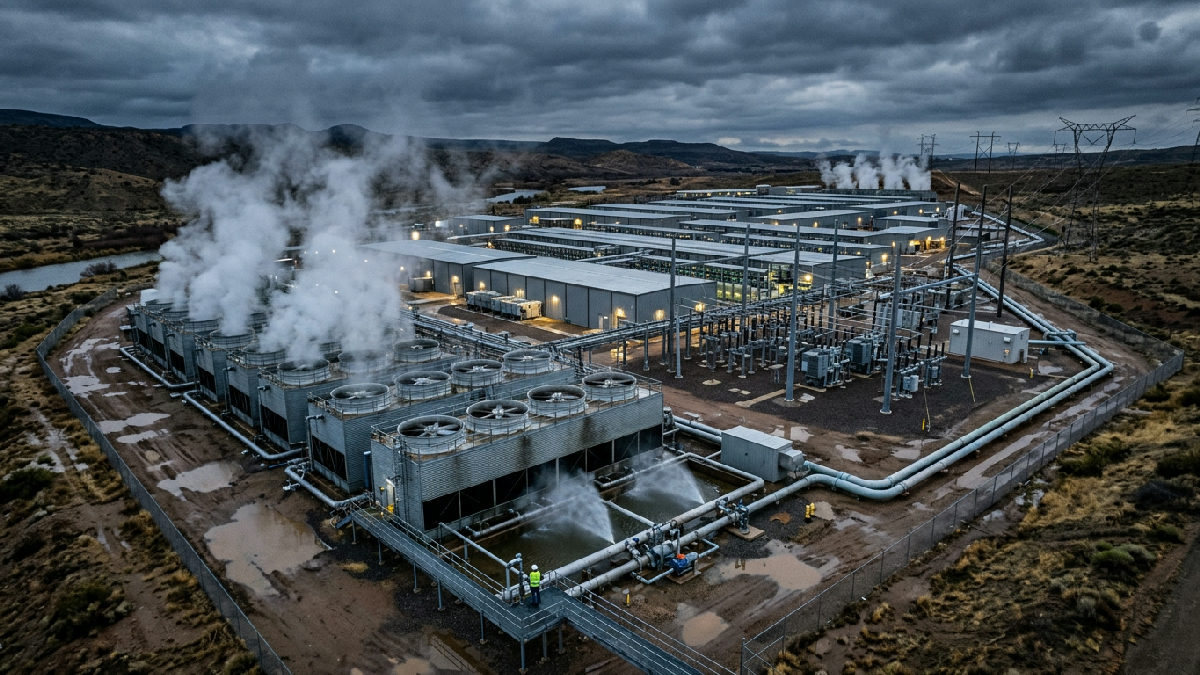
Beyond technological progress, the development of artificial intelligence (AI) brings an unexpectedly high burden on the planetary ecosystem. The UN Institute for Water, Environment and Health, in its latest report, warns that the energy intensity of data center operations already rivals the world's largest economies. According to experts, the current operating model of technologies is unsustainable in the long term, unless there is a fundamental change in resource efficiency.
According to expert estimates, data centers consumed a total of 448 terawatt-hours (TWh) of electricity in 2025. For comparison, if these sectors formed a separate state, it would be the 11th largest consumer in the world. The Czech Republic recorded a net consumption of only 59.3 TWh in almost the same period. Predictions for the end of the decade are even more ambitious, anticipating an increase in energy consumption for AI needs up to 945 TWh annually by 2030.
Thousands of billions of liters of water and land occupation
However, the carbon footprint is just the tip of the iceberg. As infrastructure expands, the demands for cooling and space dramatically increase. The UN's forecast for 2030 states that the technology sector will require 9.3 trillion liters of water and occupy an area of 14,500 square kilometers of land.
- Water consumption for AI will equal the annual needs of 1.3 billion people in sub-Saharan Africa.
- The annual volume of e-waste will reach 2.5 million tons, equivalent to the weight of 250 Eiffel Towers.
- Operating the ChatGPT system requires emission compensation equivalent to 2.6 million planted trees.
The authors of the analysis point out that merely focusing on emission reduction can be counterproductive. If the energy mix shifts towards bioenergy, the carbon footprint will decrease by 70%, but water requirements will increase thirtyfold, and the land footprint will increase a hundredfold. This interdependence of resources is often overlooked in discussions about digitalization.
Global inequality and toxic waste
Another dimension of the problem is geographical concentration. Although we speak of global technology, the infrastructure is physically located in only 32 countries. A full 90% of AI capacity is controlled by the United States and China. The rest of the world does not have direct access to this computing power but bears the environmental risks associated with raw material extraction and subsequent hardware disposal.
"We have a narrow window to ensure that the backbone of our era's technological revolution develops within planetary boundaries," said Kaveh Madani, Director of the UN Institute, commenting on the report's conclusions.
Without effective recycling, the world faces massive environmental contamination by lead, cadmium, and mercury. If technological processes that are more environmentally friendly cannot be found, according to the UN, the ecological cost of artificial intelligence development may become unsustainable for large parts of the planet in the near future.