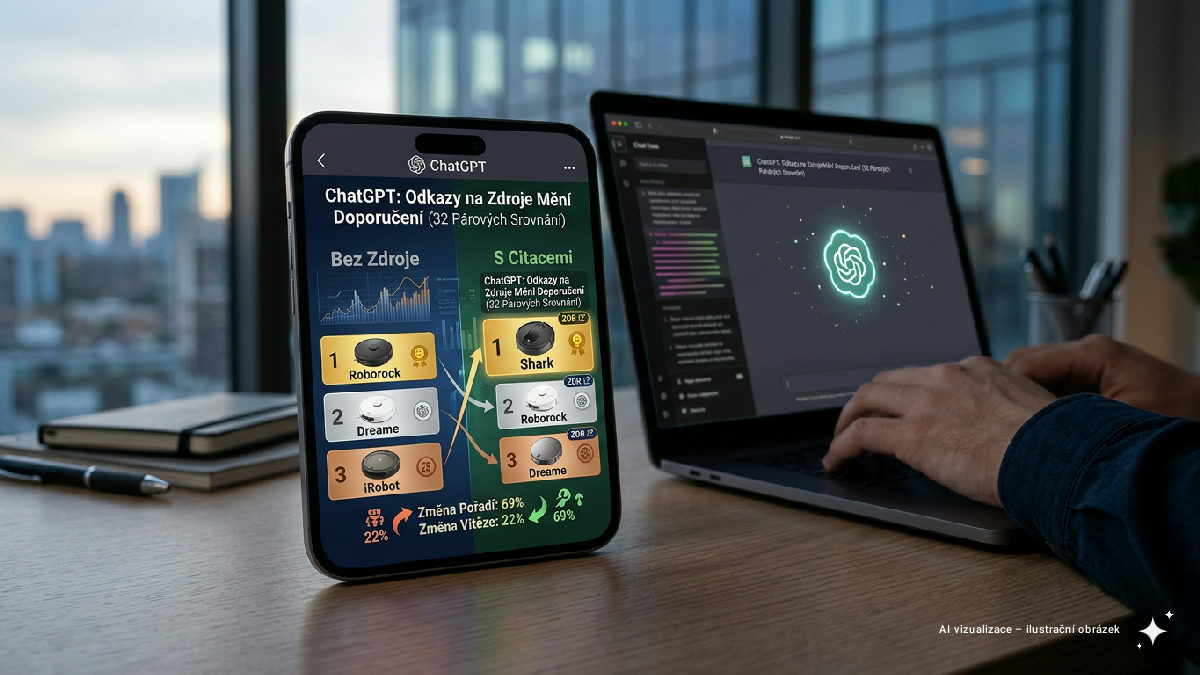
An American consumer looking for the best robot vacuum for a home with two heavily shedding cats enters a straightforward prompt into ChatGPT. In standard mode, the artificial intelligence recommends models from Roborock, Dreame, and iRobot. However, adding just a single sentence requesting sources to the exact same prompt causes the ranking to unravel immediately. Suddenly, a different brand claims the top spot, and Shark—a manufacturer completely absent from the initial response—enters the selection.
This specific example illustrates the findings of a pilot study conducted by EPEPR Research on November 22, 2026. An analysis of 32 paired comparisons showed that simply requesting references altered the top-ranked brand in 22 percent of cases. Consumers who rely on a chatbot's initial recommendations may therefore receive radically different advice depending solely on whether they ask for supporting sources.
Requesting source citations altered the composition of the top-three recommended brand shortlist in 53 percent of all tested queries.
Shifting Ranks and Changing Winners
Researchers locked in a total of 30 purchasing queries tailored to the US market, dividing them into three categories: robot vacuums, carry-on luggage, and password managers. In each scenario, ChatGPT was required to select three specific brands and state the primary reason for recommending them. While half of the queries were submitted straightforwardly, the other half included the addendum: “Cite a source for each recommendation.”
The impact of this minor prompt tweak on response stability was substantial. Beyond the frequent dethroning of the top-ranked brand, 69 percent of comparisons saw a change in the overall order of the recommended trio. The data suggests that requiring citations forces the AI to retrieve specific web pages, which can vary across runs, resulting in inconsistent outcomes for the end user.
Key findings of the pilot study by the numbers:
- 22% of cases — the share of comparisons where the absolute top recommendation changed after asking for sources.
- 22 of 32 responses — the number of instances where the sourced version provided direct links, compared to just 9 in standard answers.
- 53% of queries — the frequency with which at least one brand entered or left the shortlist.
- 10 shortlist changes — the result of repeating the identical sourced query in a fresh chat, confirming the system's volatility.
Which Products Are Most at Risk
The research revealed that the degree of volatility varies depending on product category. ChatGPT proved most "fickle" in the robot vacuum category. Here, prompting for sources shifted the top-ranked product in 4 out of 11 tests, and the shortlist composition reshuffled in 8 out of 11 cases. Conversely, password managers yielded the most stable outcomes, with the top pick changing only once in ten attempts.
Another compelling finding was the algorithm's behavior when repeating the exact same prompt in a clean chat window. While standard queries retained a stable first-place recommendation, queries with sources swapped the category leader in 3 out of 12 repetitions. This indicates that the real-time external retrieval process introduces a higher degree of randomness or dependency on currently accessible indexed pages.
The rank order of recommended brands shifted in 22 out of 32 cases, even when the exact same manufacturers remained on the shortlist.
Fact-Checking Sourced Claims
The researchers also investigated whether cited pages actually contained the information upon which ChatGPT based its endorsements. A deep-dive audit of 18 selected recommendations across the three main categories (vacuums, luggage, password managers) revealed that 16 claims were substantiated by the cited source. In the remaining two instances, verification could not be completed because the target destination text was inaccessible.
“Cite a source for each recommendation.”
Sentence used in the test prompts for ChatGPT
For example, when recommending a Briggs & Riley suitcase, ChatGPT linked to an official repair manual that verified easy wheel replacement, which was the core rationale for the recommendation. Similarly, for password managers such as 1Password or Bitwarden, links pointed directly to family plan pricing tiers confirming shared vault capabilities. However, subjective evaluations such as "ease of use" remained solely the model's judgment rather than factual data drawn from the link.
Takeaways for Shoppers and Brands
For everyday users, the data suggests a clear shopping strategy: never rely on the first response. It is advisable to run the same prompt multiple times in fresh conversations, combining variations with and without source requirements. Only brands that consistently appear across all configurations can be viewed as true algorithmic favorites.
At the same time, this highlights a critical avenue for marketing teams. Businesses should ensure their websites feature clearly indexable pages detailing technical specifications, warranty terms, and self-repair guides. Documents like sustainability reports and repair manuals were precisely what ChatGPT cited most often when pushed to back up its claims. A brand's future visibility in AI-driven commerce may well depend on how seamlessly a model can anchor its recommendation to verifiable facts on the manufacturer's website.
The pilot study has its limitations, as it represents a single-day data sample from November 22, 2026. Rate limits on anonymous messages within the free ChatGPT tier ultimately yielded 65 usable responses out of the planned 120. A subsequent research wave will examine whether these recommendation shifts persist over longer periods and across different foundational models.