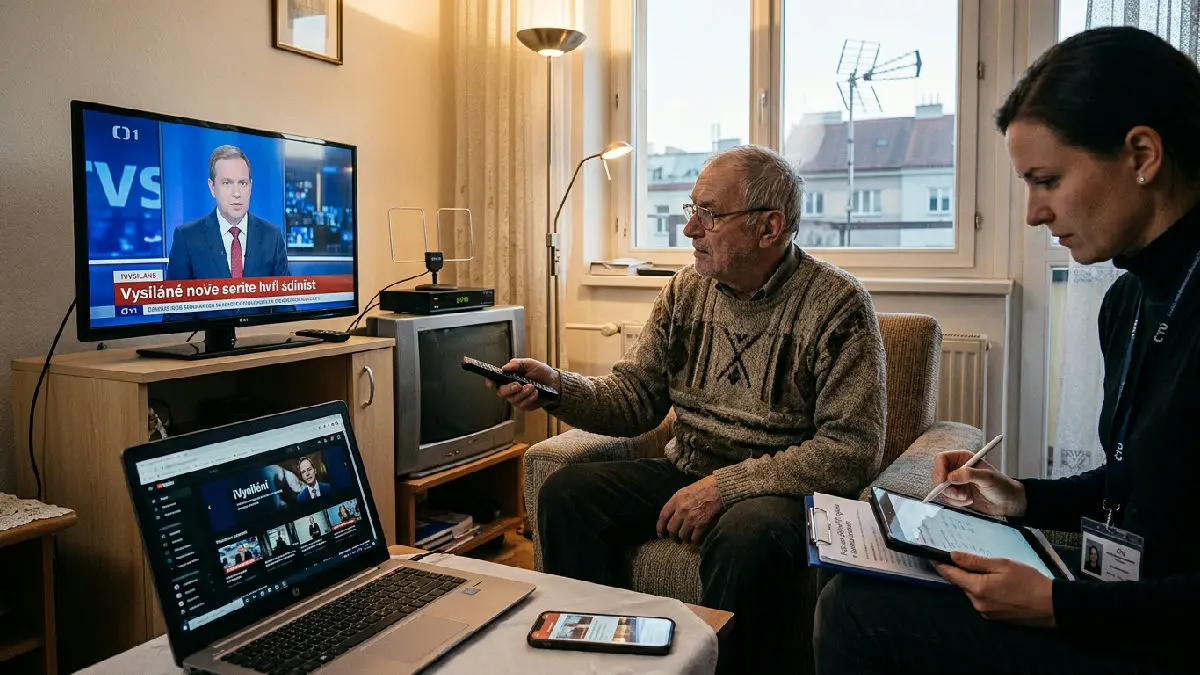
The future of terrestrial television broadcasting in the Czech Republic is entering a crucial phase. The Czech Telecommunication Office (CTU) has already selected a company that will carry out extensive monitoring of how television signals are received in Czech households in the coming years. This information was confirmed by CTU Council member Jiří Šuchman at the DIGIMEDIA expert conference, stating that the office would only announce the winner's name after the official signing of the contract.
This research is not a classic viewership measurement but a strategic tool for public administration. The data will serve as the main basis for decisions on the fate of the 600 MHz frequency band after 2030. It is precisely in this period that a fundamental debate is expected at the pan-European level on whether these frequencies will remain reserved for the DVB-T2 standard or whether they will be released for the benefit of mobile data services and the development of next-generation networks.
The project will focus on a representative sample of several thousand households and will be conducted repeatedly to capture long-term trends. The subject of the research will be not only terrestrial broadcasting (DVB-T2) but also IPTV, cable television, satellite reception, and the use of streaming platforms. The office wants to gain an accurate overview of how viewers' habits are changing over time.
The Czech Republic is in a specific situation because millions of households still use free-to-air antenna reception here. Although terrestrial broadcasting has a very strong position in the country, pressure to release spectrum for telecommunication operators is increasing. A similar process has already taken place for the 700 MHz band, which required the technological transition to the DVB-T2 standard.
“According to the Radio Spectrum Management Strategy, the state wants to make decisions primarily based on real data on viewer behavior and technological development,”
states the documentation for the project. The research will thus directly affect the shape of the television market in the next decade. According to Šuchman, CTU has already moved from theoretical preparations to the implementation phase, and after signing the contract with the selected supplier, data collection will begin, which may definitively determine whether terrestrial television will maintain its scope or have to give way to mobile networks.