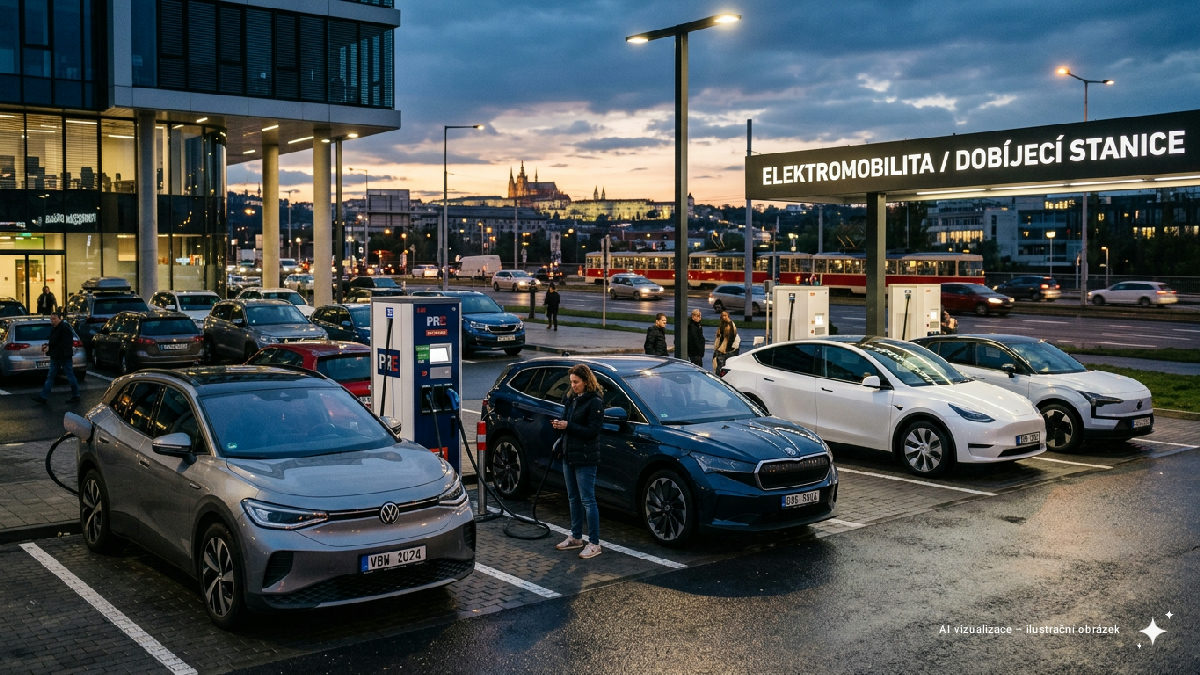
Czech roads are undergoing a noticeable transformation, confirmed by the latest vehicle registration statistics for the first ten months of 2026. While electric vehicles accounted for 5.6% of the new car market last year, their share has now climbed to 7.6%. In total, more than 83,000 battery electric passenger cars are currently in operation across the country.
From January to the end of October 2026, 15,626 new battery electric passenger cars (BEVs) were registered in the Czech Republic, representing a year-on-year increase of 37%. The market's momentum was particularly evident in October, when 1,820 vehicles were registered—a 44% jump compared to the same month last year. However, growth is not limited to new cars; imports of used electric vehicles from abroad also recorded a dramatic 59% surge.
Registrations of new electric passenger cars in the Czech Republic rose by 37 percent, while the imported used EV market surged by a record 59 percent.
Market Structure and the Dominance of Combustion Engines
Despite double-digit growth for electric powertrains, the Czech new car market remains dominated by internal combustion engines. Petrol engines retain a 64.9% market share, down slightly from last year’s 67.5%. Diesel engines held steady at 20.2%. However, the plug-in vehicle segment—encompassing both pure electric vehicles and plug-in hybrids—strengthened from 9.9% to a total of 12.7%.
The market breakdown by powertrain type for the monitored period is as follows:
- Petrol — holds a majority share of 64.9% of the new car market.
- Diesel — maintains a stable position with a 20.2% share.
- Battery electric vehicles (BEVs) — rose to 7.6% from 5.6% last year.
- Plug-in hybrids (PHEVs) — account for 5.1% of all registrations.
- Liquefied petroleum gas (LPG) — saw a slight decline to 2.3%.
Škoda Auto Reaffirms Its Leadership
Domestic automaker Škoda Auto maintains a dominant position in the EV segment with a 33.3% market share. The best-selling model in the Czech Republic is the Škoda Enyaq, with 2,414 registrations. The model proved so successful that it ranked 12th overall among all new passenger cars, regardless of powertrain. Second place goes to the Škoda Elroq, although its registrations dipped 9% year-on-year to 2,148 units.
The new Škoda Epiq also made a notable debut, securing fifth place overall among electric vehicles with 382 registrations. Among the top players, the Tesla Model Y rounded out the top three with 1,548 registrations. Together, these three key models accounted for 39.1% of all newly registered electric passenger cars in the country.
The Škoda Enyaq became the 12th best-selling car in the Czech Republic across all powertrains, confirming its strong domestic market position.
Expanding Portfolio and Growing Competition
A major trend in 2026 is market diversification. While traditional leaders Škoda and Tesla grew by 21% and 27% respectively, other brands on the market expanded by a combined 51%. Among the top ten brands, only Hyundai suffered a year-on-year drop in registrations, falling 12%. Model variety is also widening—while customers could choose from 131 different EV models last year, there are now 172 available.
“Behind the growing interest in electric vehicles from other brands is an expanding lineup of models, the arrival of new manufacturers, and intensifying competition across all price categories.”
Electrification of Commercial and Freight Transport
Low-emission technologies are also gradually making inroads into the commercial sector. Electric vehicles now account for 9.5% of all registrations in the light commercial vehicle category, representing 1,694 vehicles. Adoption remains slower in heavier vehicle segments, yet 115 electric trucks and 47 new electric buses were registered. The market for imported used electric cars reached 11,284 vehicles, meaning that every twelfth imported used car (8.4%) now runs on battery power.
The shift toward clean mobility in the Czech Republic continues to accelerate, bolstered by the entry of new manufacturers into the market. Whether the 37% growth rate can be sustained through the end of the year will depend on statistics from the remaining two months. An open question remains how quickly other brands can chip away at the market share of established players, and whether the downward trend seen in certain established models can be reversed.