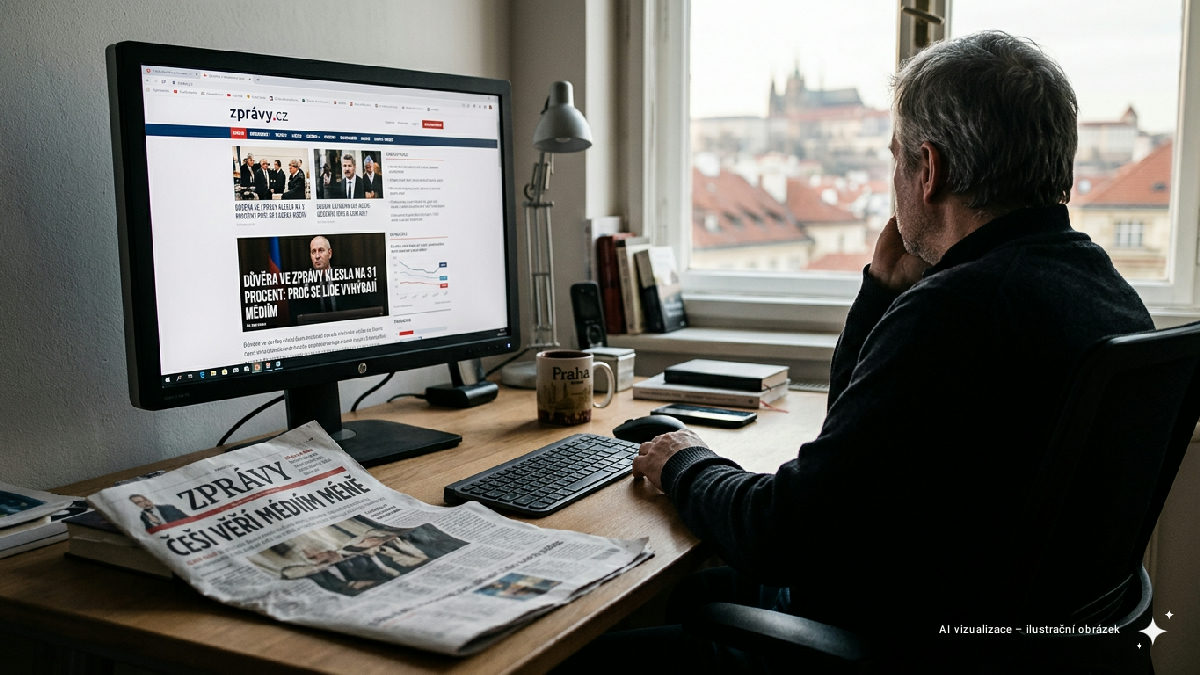
When the average Czech opens the morning newspaper or launches a news portal, they are increasingly accompanied by doubts about the veracity of the information presented. Current data show that the willingness to trust media in the country is systematically declining, reaching levels that indicate deep public skepticism towards journalistic work.
According to the latest Digital News Report survey, Czechs' trust in news has fallen to 31 percent this year. This represents a drop of two percentage points compared to the previous period. This development is not just a local peculiarity but reflects a broader pan-European trend where people are beginning to turn away from traditional information sources.
Czechs' trust in news fell to 31 percent this year, a year-on-year drop of two percentage points.
European Context and Differences in Trust
The study results suggest that Europe is not uniform regarding media trust. Although a similar trend to that in the Czech Republic appears in many other countries, there are significant differences between individual nations. While some regions maintain a more stable position, in others, the decline in news authority is critical.
In addition to the drop in trust, the phenomenon of news avoidance is also emerging in society. People consciously choose not to consume current events, which may be related to information fatigue or a sense of futility regarding content quality. This trend goes hand in hand with growing distrust in the objectivity and independence of newsrooms.
The Digital News Report identified several key factors contributing to the current situation:
- Year-on-year decline — trust in news decreased from 33 to the current 31 percent.
- European trend — the decline in media authority is evident in many other EU countries.
- Information fatigue — an increasing number of residents intentionally avoid news.
- Crisis of independence — strong suspicion of external influence on editorial content persists.
Role of Owners and Influence on Content
One of the strongest findings of the current report is the Czech public's conviction about the non-transparent background of media houses. Czechs are strongly convinced that the final form of news is significantly influenced by media owners. This concern about pressure from business or political structures on newsrooms is one of the main drivers of declining credibility.
Czechs are strongly convinced that the form and content of news are directly influenced by the owners of media houses.
The question of ownership structure and its impact on journalistic independence thus becomes a central point of public debate. Data show that it is increasingly difficult for readers and viewers to distinguish independent news from information that may serve the specific interests of owners, leading to overall apathy towards both public and private information channels.
Future Outlook and Unanswered Questions
The Digital News Report, facilitated by the agency LESENSKY.CZ, does not specify concrete steps that media intend to take to reverse this negative trend. It is not yet clear whether strategies exist to enhance the transparency of ownership structures, which could convince a skeptical public of their impartiality.
Future developments will depend on how the Czech media market copes with the pressure of digital transformation and whether it can effectively respond to the phenomenon of news avoidance. The drop to 31 percent, however, represents a warning signal for publishers and journalists that the current way of communicating with the public is no longer working.