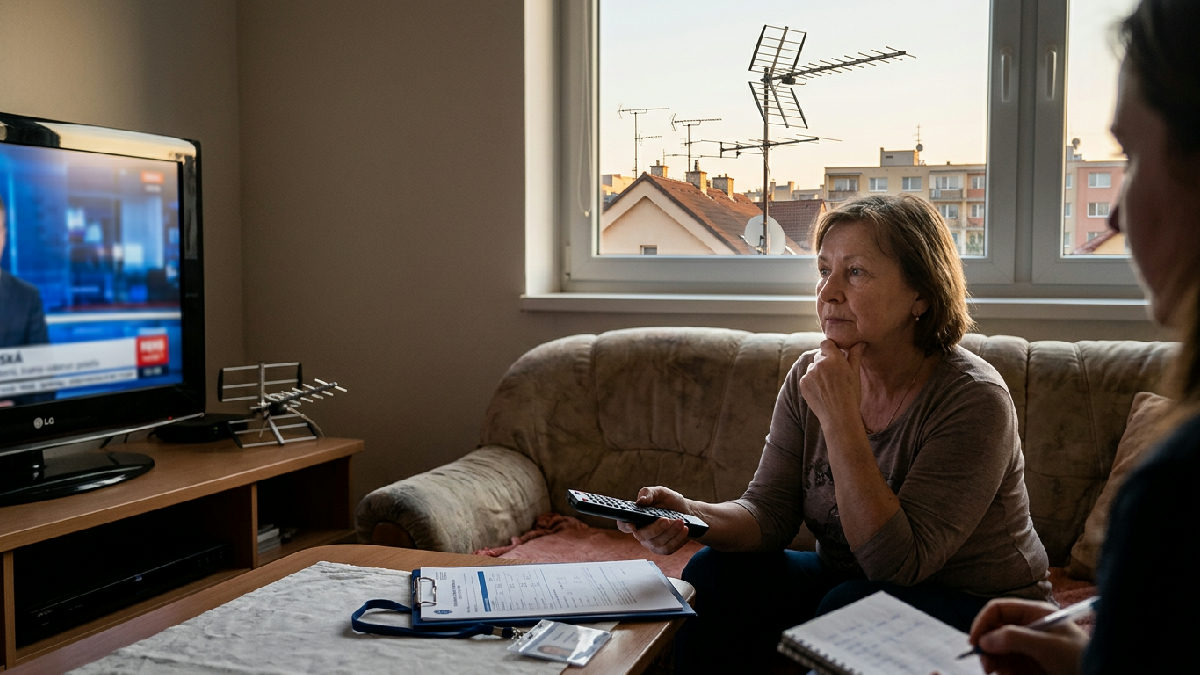
The Czech Telecommunication Office (ČTÚ) has initiated a process that will determine the future form of television broadcasting in the Czech Republic. The office is currently finalizing the selection of a research agency for an extensive three-year project. From 2026 to 2028, an annual household survey will be conducted, the results of which will become a key basis for decisions on the extent to which terrestrial digital broadcasting (DVB-T2) will be maintained after 2030, when the current frequency allocations expire.
Marek Ebert, Chairman of the ČTÚ Council, confirmed that the goal is not the demise of the terrestrial platform as such, but finding an optimal scenario for its continued operation. The research will focus on a representative sample of 3,000 households and will always take place in September and October. The survey will map not only preferred distribution platforms, but will also focus on socially disadvantaged groups and residents in remote areas for whom "TV via antenna" represents the only free alternative to paid services.
"Our interest is to find a suitable scenario for supporting and continuing terrestrial television broadcasting even after 2030. We will investigate what customers demand and how the situation is developing," stated Marek Ebert.
The study will also monitor technological trends, such as the use of hybrid broadcasting HbbTV, the increase in content consumption over the internet, and the position of streaming services. The data collection methodology is based on European Commission recommendations, which will allow for a comparison of Czech data with other EU member states. According to Miloš Mastník, CEO of České Radiokomunikace, approximately two million Czech households (approx. 49% of the market) currently rely on terrestrial reception, which is an above-average share in the European context.
The obtained data will undergo public discussion in an expert panel, where operators and content providers will be seated. At the same time, the lucrative UHF frequency band is at stake, which mobile operators are interested in for expanding data networks. Commercial televisions Nova and Prima have previously declared their interest in maintaining terrestrial broadcasting until at least 2040 and 2050, respectively. The ČTÚ will also release the unused networks no. 25 and 26 for temporary regional operation and experiments with new technologies, such as 5G Broadcasting, valid until the end of 2030.
An international decision on the fate of the remaining spectrum is expected at the World Radiocommunication Conference in 2028. The domestic Radio Spectrum Management Strategy assumes that specific conditions for the UHF band after 2030 will begin to be discussed in the second half of 2028, precisely based on freshly collected data from the ongoing research.