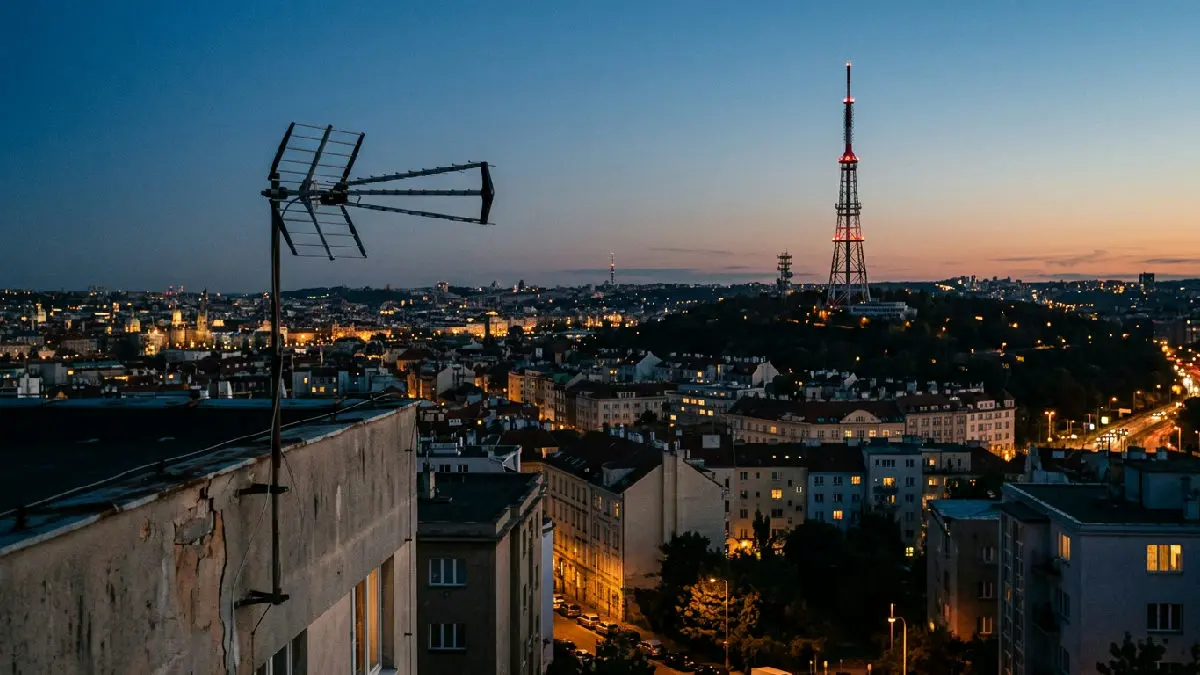
The future of free television reception and spectrum management after 2030 was the main topic of the Innovation Days 2026 conference. Current data confirms that Digital Terrestrial Television (DTT) remains the dominant platform in the Czech Republic, used by 49% of households, representing approximately 2.1 million entities. According to sector representatives, this infrastructure remains stable despite the rise of paid services, and multiplexes are currently fully occupied.
Miloš Mastník, CEO of České Radiokomunikace (ČRA), highlighted the economic attractiveness of the platform even for broadcasters themselves.
Today, DTT multiplexes are occupied; six new channels have been added in the last two years. If terrestrial broadcasting were not economically attractive, the situation would look completely different," Mastník stated.
He also emphasized that the 20 most watched channels within terrestrial broadcasting generate an 86% share of viewership. In addition to being free for end-users, the platform's energy efficiency and its capability for crisis communication thanks to robust infrastructure covering 99% of the population were highlighted.
The discussion also focused on the social aspect of a potential decline in free broadcasting. Senator Jiří Vosecký warned that a significant portion of the population lacks sufficient economic strength to regularly pay subscriptions for data to mobile operators. He also pointed out technical limitations, where even in Central Bohemia, there are still areas without adequate mobile signal, while television signal is available.
Representatives of the broadcasting sector perceive mobile operators' efforts to acquire television frequency spectrum as a threat to economic competition. According to Mastník, moving away from free broadcasting would mean a financial burden of approximately 10 billion Czech crowns annually for Czech households, which, instead of free reception, would go to operators for internet access. The calculation is based on an average price of 400 CZK per month for connectivity for two million households.
Experts see the future of the industry in the synergy of technologies. Testing of the 5G Broadcast standard is currently underway, which should enable the efficient dissemination of television content to mobile devices without consuming data limits.
We believe that technologies do not have to compete with each other. OTT, HbbTV, and DTT platforms form a direction that makes technological and business sense,” Mastník concluded.
The Czech Telecommunication Office (ČTÚ) is currently preparing a spectrum utilization strategy for after 2030. Its chairman, Marek Ebert, confirmed at the conference that the office is taking steps to define a long-term framework that will determine how frequencies will be allocated between television broadcasting and mobile services in the next decade.