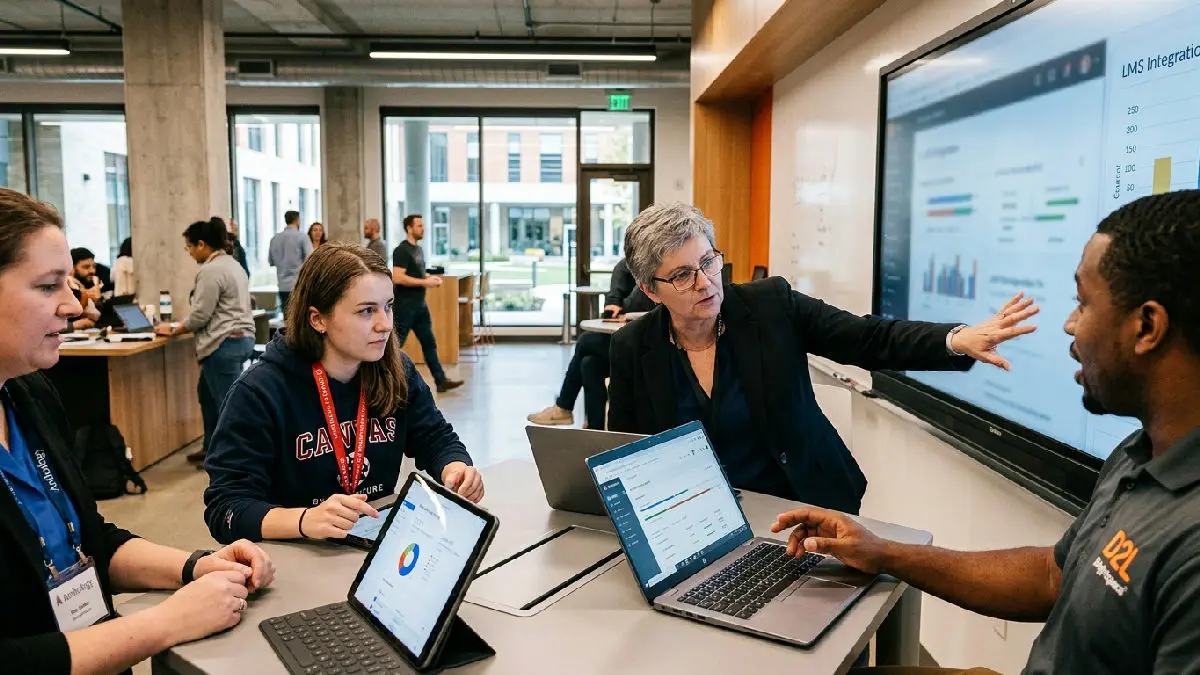
The Learning Management System (LMS) market in higher education is undergoing dynamic development. Key global players such as Instructure with its Canvas platform, D2L offering the Brightspace system, and Anthology with its Blackboard product, are currently battling for dominance in the digital transformation of universities. This segment no longer focuses merely on storing study materials but on in-depth data analysis and personalized learning paths.
The current leader in the North American market remains Instructure, whose Canvas platform relies on an open ecosystem and easy integration with third-party applications. The company's strategy in recent times has focused on acquiring complementary tools that extend the capabilities of the basic LMS with elements for skill assessment and lifelong learning, which is a key topic for modern educational institutions.
Competitive Battle and Technological Progress
Hot on the heels of the leader is primarily D2L, which, with its Brightspace solution, positions itself as a technologically more advanced alternative with an emphasis on adaptive learning. D2L targets institutions that require a high degree of flexibility in course design. The third significant player, Anthology, after merging with Blackboard, is striving to create a comprehensive ecosystem that connects the academic environment with school administration.
Integration of artificial intelligence for content creation and feedback.
Emphasis on mobile accessibility and inclusivity (accessibility for people with disabilities).
Utilization of advanced predictive analytics to identify students at risk of failure.
Expansion of certificates and micro-credentials beyond standard diplomas.
According to market analysts, these three entities account for more than 60% of the market share in developed regions. Universities, when selecting platforms, increasingly look not only at the license price but also at the total cost of ownership and the vendor's ability to provide long-term technical support in an era of rapid innovation.
Future in Data and Flexibility
The transformation is shifting towards so-called “data-driven education.” Systems no longer serve only as passive storage but actively suggest to educators how to improve student engagement. Precisely the ability to effectively work with large volumes of data will be the main differentiator in the market in the coming years, determining the success of individual platforms.
“Technological ecosystems must be able to grow with the needs of students and teachers in real-time,” industry representatives state in connection with the growing demands for hybrid forms of teaching.
Although the strategies of individual providers differ slightly, the common denominator remains the pressure to consolidate the market. Smaller regional providers are gradually being absorbed by large players or pushed out by global standards that large platforms define.